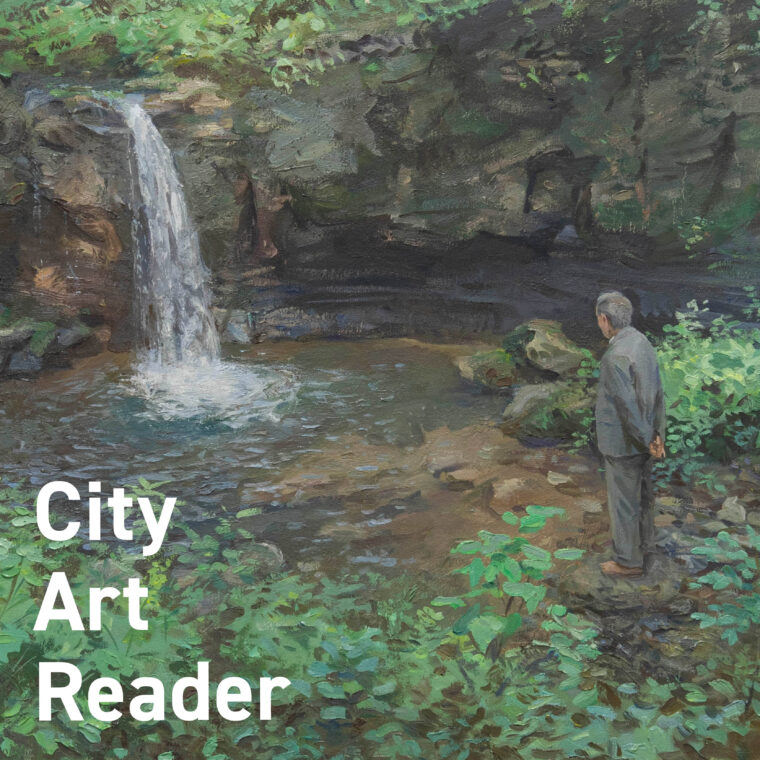
In Ōtautahi Christchurch based painter Rupert Travis’ latest exhibition of paintings ‘Radio Silence’, ambiguous scenes are painted with a dream-like, timeless quality. Ahead of the exhibition which runs 17 March to 13 April 2026 at City Art Depot, he spoke with City Art Reader editor Cameron Ralston at his new Woolston studio.
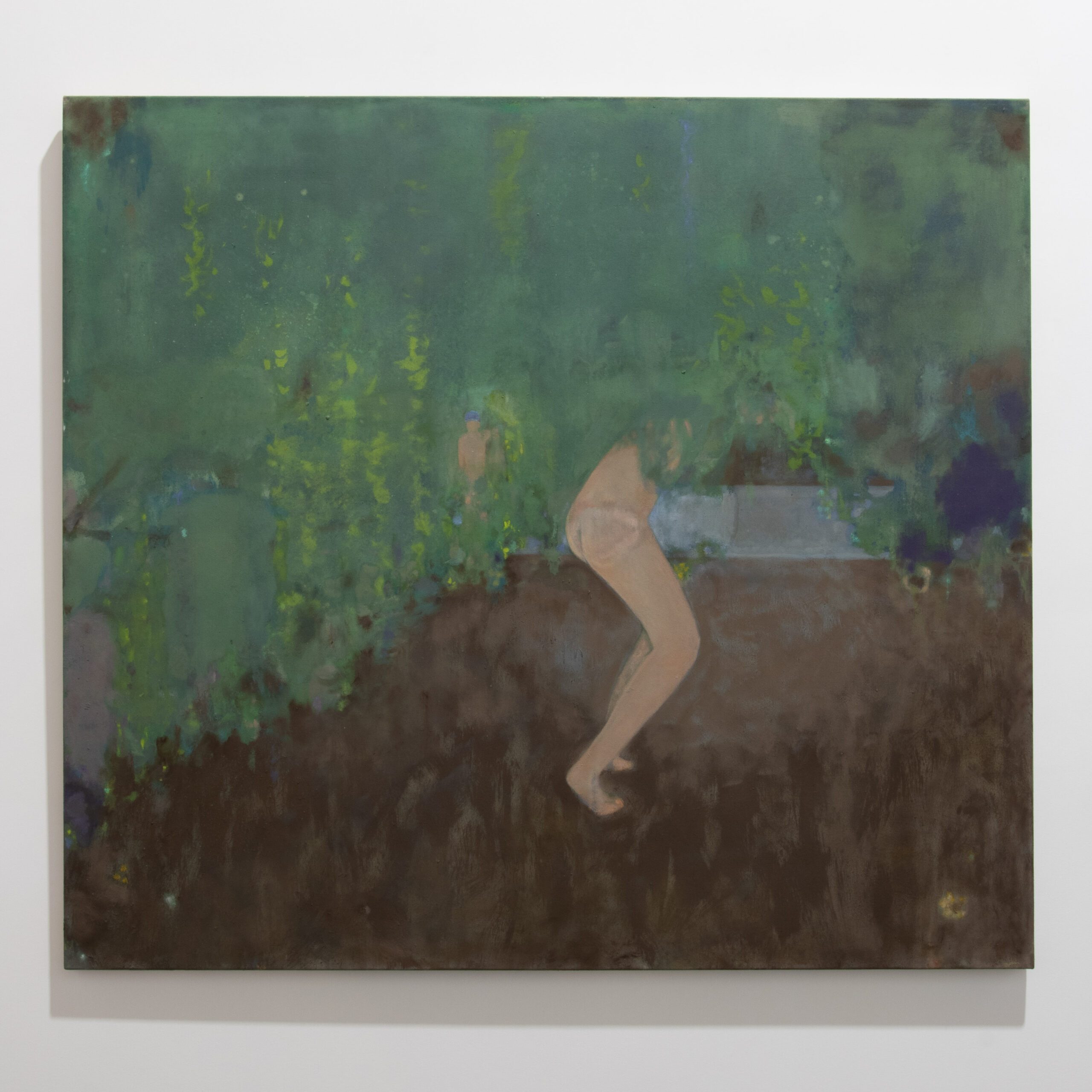
Naakt, oil on canvas, 1370x1520mm
Cameron Ralston: For your previous exhibition at City Art Depot you were working off your photographs – is this the case with this body of work too?
Rupert Travis: A little bit. This series started from old National Geographics that I used to collect when I was younger. I think I have about 200 of them. I was looking through those, getting ideas, slowly mapping out works through that. That led me into this sort of narrative of a journey, a journey without time.
What do you mean by that?
I try to avoid time signatures, or time stamps, in which you can place when a scene happened. There’s something quite interesting about, it could be 50 years back, it could be 100 years back.
So, these paintings don’t have so much of a biographical nature to them?
I’d say they still do a little bit. The works are partially dreamed up, which in a way comes from self. Then they’re partially built up from found images. A couple from memory. But again, the biographical element comes from what I’m drawn or connected to. It’s not a direct biography, but a biography of interest or want.
Your works are quite surreal in this show. The interaction of colour and texture feel dream-like. Then the way that faces and bodies are cut off or obscured. There’s a lot of withholding of information.
I think the more you can strip it back, the more it forces the viewer to bring their own interpretation to the work. Similar to when you wake up and try attribute a meaning to what you’ve dreamt about, you try and fill in the blanks. Often it will be a very ambiguous, vague scenario.
So, you’ve used certain devices in the way you paint to get that?
I think, especially with the small works, they can be read as abstracts. But I always have the reoccurring line of the horizon. There’s something that balances and gives it grounding. I remember reading about Rothko. Although he’s considered an abstract painter, you can also argue that he’s actually figurative because everything’s a landscape. And it’s just because of that horizon line. Maybe that’s what gives us comfort.
I wouldn’t necessarily call these paintings comfortable, perhaps due to the extent of the abstraction, the removal of graspable details.
I think there’s always that balance within work. What I aim to do is create this mystique or air of something being off but always bring it back to something that settles or relaxes you. And for me, that can be something as simple as a charcoal line.
Where do you want your works to fall on that scale of difficulty?
I’ve been thinking about this recently because I’ve been looking at artists like R. B. Kitaj and Marc Chagall. Chagall is someone I never really looked at because I found his works quite loud and busy. To me they’re quite challenging, they’re not meditative. But the more I look at them, the more interested I become in them. I think that challenge can keep you engaged. So, for me, with painting, I’m always trying to find a balance between it. Rather than using colour like Chagall, I tend to try and create more of a conversation through the composition. A conversation between two figures or two objects. One in the foreground, one in the background, which can create this area of disconcertedness. But then there’ll be something quite, again, relaxing about colour or line.
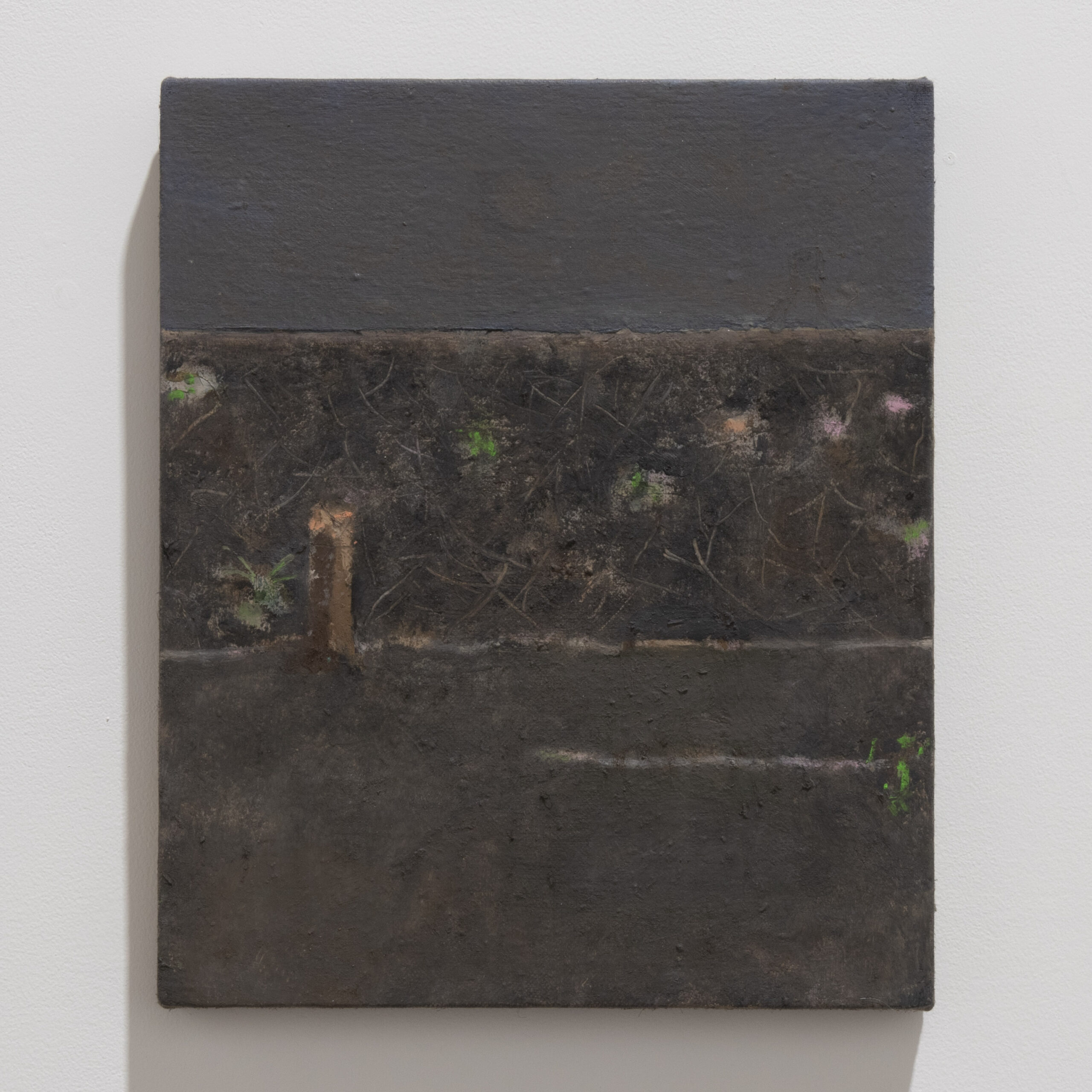
In Transit, oil on canvas, 300x250mm
You’ve spoken previously about being interested in paintings as objects. Is that something that you’re applying to your paintings, and does it alter your approach to the finished piece?
Yeah, I do. This study of three ships for example has been painted on a recycled coffee sack. I like that when you turn it around there’s the remnants of whatever the coffee brand was. I used to frame a lot of my work. And although I’m still interested in what a frame can do, I quite like being able to see the paint marks on the side of the support when you purchase it. I think after it’s been purchased, whatever happens with framing is the collector’s choice. I think up until that point, there’s something quite interesting about being able to see the dirtiness or the messiness.
Yes, viewers often have contrasting opinions on how the edge of a painting should be finished.
I think in not framing or tidying the edges for a show, it feels to me more like a studio visit, more raw, more rough.
I like that you’re sort of embracing that element in your work. Though I’m not sure I’d go as far as to call it a roughness.
I’ve always tossed up what to do with the edges of a painting. I actually did begin with masking tape around these works, and then halfway through the process of it I took the masking tape off. The stark, clean edge around the canvas just didn’t work. I found it odd to look at because historically I’ve always worked by throwing the canvases on the ground and moving them around. They’d get sort of dirty. I can see the reason why people would want to frame them. But at the same time, I like it. I think it challenges that prestige art often has. You see art being sold in auctions handled with white gloves, but if you visited a lot of those artists in their studios during the making process, they’d be throwing them around.
It’s true that once you prescribe the value to something, that becomes part of it. Equally, once it leaves what can be considered the artist’s intention, there needs to be some kind of preservation of the object as it is being exhibited.
I think there’s something quite fun about challenging that. Showing the working and handling. In the past, I’ve done quite minimal abstracts at times, and I’ve always framed them. The frame was intended as an extension of the work, a device used to hold your attention to the work. Whereas in this series especially, I’ve tried to focus more on what the composition is doing and how your eye travels across the canvas. How it retains your interest. The sweet spot is to create this moment within the work that never really reaches a side, it stays on the work.
Composition is obviously very important to you. Do you have a very plotted out process or are you more responsive?
More intuitive. I don’t think there’s a single work that stayed as it started. I think whenever I’ve tried to plan a work from the get-go, I’ve had a tendency to fall on tropes or use formulas. But, as we were talking about before, that can often lead to quite a simple or easy work. I think you lose some of that chance. It’s very hard to create chance, it’s very hard to let paint have its own autonomy when you know exactly what you’re trying to do.
With that said, Nobody You Know pretty much stayed how it was planned out. It’s probably the only work that from the get-go just worked. Part of that success is in being quite pushed back in places and built up in others. I really just wanted that painting to be a play of line. Whereas for the other works, I like to create moments, or pockets, of layers. Finding interesting mistakes and then working with them. It’s like when you sand back the walls on a house and you see every layer that came before.
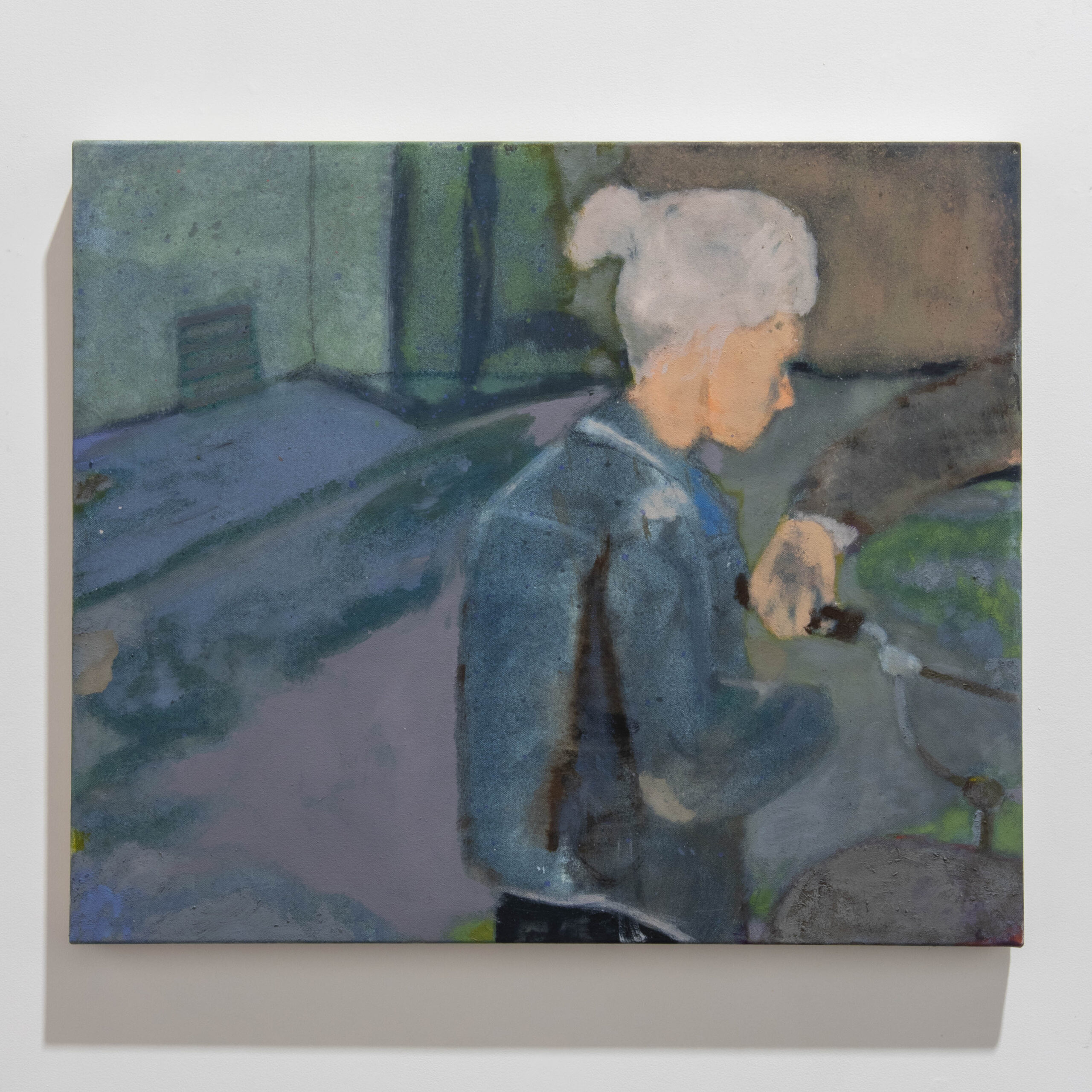
Nobody You Know, oil on canvas, 560x660mm
You create negative and positive space within the imagery, colour and composition. But there’s also something that goes on within your paintings, which is a kind of interaction with the quality in which something is painted.
In the making process, I always think about what’s the weight of narrative versus aesthetic. I think that’s why I sometimes veer towards abstracts because narrative will often hold interest for a lot shorter time than the actuality of the surface. I believe an artwork should change as you get older. If you’ve got a work hanging up in the same spot for 20 years, as you grow and your life changes, the work should adapt. I think there should be an element of looseness to an artwork that should allow that open interpretation.
Are you consciously trying to cultivate an aesthetic or style within your work? Is that important to you?
It is. I think it’s important to find a style but not attach yourself to it. I find small threads that follow through each show. I think innately style knits through all the work subconsciously. I think everyone’s drawn to certain colours and sentiments in line. That said, I find it interesting to build up a work and see how it changes and ends somewhere that is unexpected.
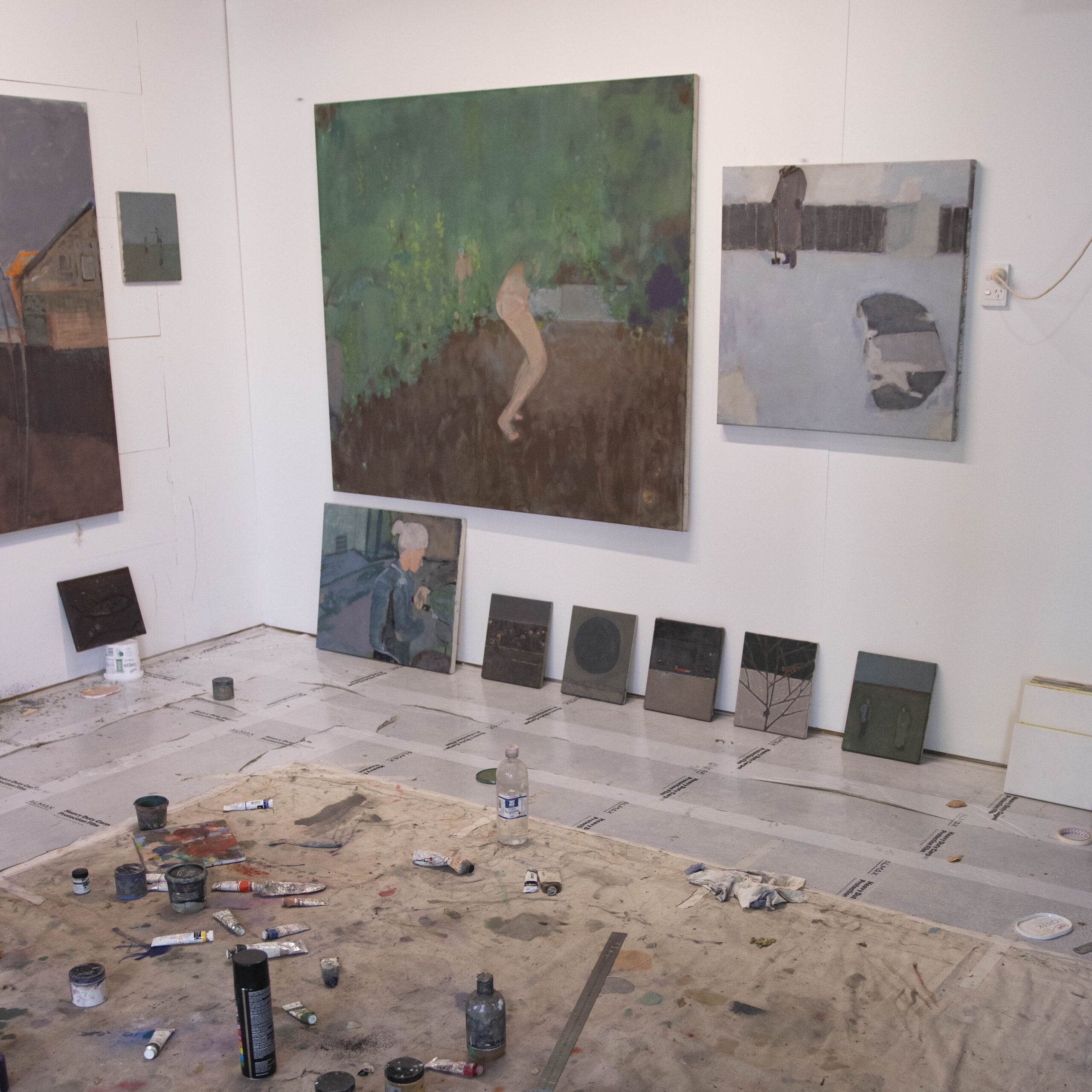
Rupert Travis’ studio
You’re now working out of this studio space, a modified garage at your home. Has that prompted any sort of change in your painting? Has it fed into your practice?
The big change since my last exhibition is that previously I was painting in France, which put me on a deadline of about 8 months of painting. Whereas the paintings in Radio Silence have been part of a series of works painted over 14 months which is still ongoing. For me, it creates a more fluid way of working. I find it very hard to plan a show and stick to it. I think I need that freedom to throw away work without feeling like I need it. But that’s a privilege.
I think the biggest shift with this space is having more freedom to explore. When you don’t feel pressure, you sort of revert back to your childlike instincts of just having fun and playing around and trying new things, which I think is when the most interesting stuff happens. I think when you wreck a work and then have to work backwards and see how to find it again or redeem it, you get this playfulness that comes through. For me, whenever I’ve tried to stick to the plan right from the get-go, it’s ended up very rigid. When there’s a feeling of something not working, I can put it away for six months, come back to it with new eyes, and perhaps something that’s caught my eye since, an image or object in passing, suddenly works for that painting. What’s incredible about painting is you can have a work that’s a complete disaster, then you can change one thing about it, and it suddenly just starts to work.
There’s a kind of pliability to your paintings, where because you’ve created so much ambiguity in there, it allows the viewer to pull it, stretch it with your eyes a little bit and get in there. In initial viewing and, as you say, over time, fill it in.
I like to think of the compositions as rarely ever stagnant. There’s something narratively that has happened or is about to happen that has resulted in the scene that is being depicted. I find that interesting. Does a work exist only within the moment that is being depicted, or is there something else that we’re not privy to?