In ‘I’m somewhere else now’ Ōtautahi Christchurch artist Saskia Bunce-Rath seeks to create a visual language through her embroideries that embodies journeys, dimensions, mysticism and a sense of joyfulness. Ahead of the exhibition she spoke with City Art Reader editor Cameron Ralston. ‘I’m somewhere else now’ opens 5.30–7pm Tuesday 25 March and runs through to 14 April.
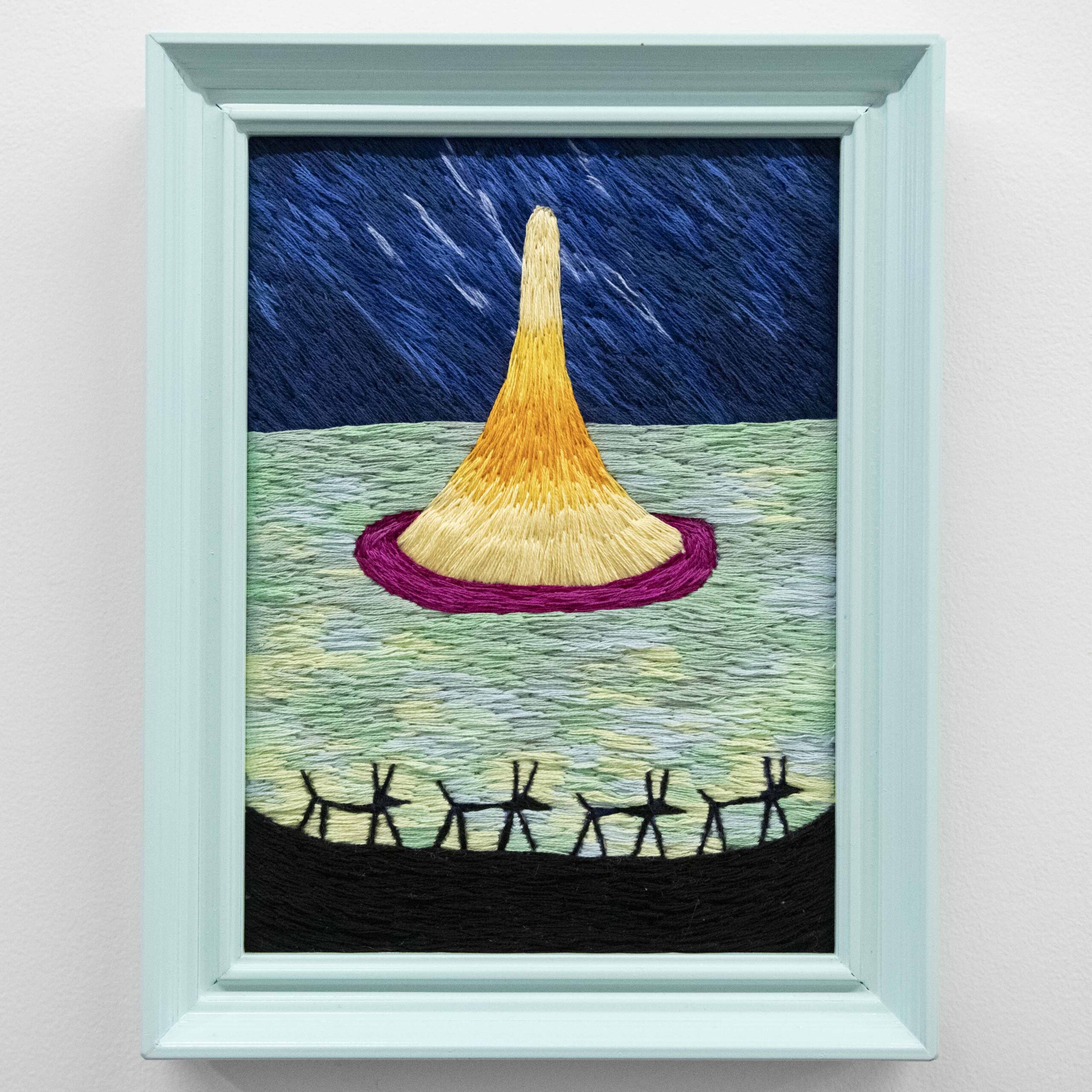
in faraway orbits, embroidery thread on calico fabric (framed), 206x160mm, 2025
Cameron Ralston: You’ve mentioned that you’re not quite sure what this show is necessarily about.
Saskia Bunce-Rath: Well, I have some ideas, but it hasn’t quite coalesced. I was really fascinated by a book I read last year called ‘Thought-Forms’ by A. Besant and C. W. Leadbeater. It’s a theosophical, non-fiction book from the early 1900s. It has these fascinating illustrations in it that are meant to correspond to ideas of human emotion, colour and shape, and how those concepts manifest in artwork. It was a book that Kandinsky was inspired by. So, some of the symbols in my artworks are inspired by imagery from the illustrations. It was like a book on colour theory, but not your traditional colour theory. It was more about how colours have emotions or how mental states manifest in colour and shape.
Do they have anything to do with like subject matter of your artworks?
In a way I suppose. For example, one part of the book talks about the emotion of anger, and how this manifests its shape and colour in a particular way. Kind of like an aura given to an emotion, but in an artwork. So in relation to my artwork the colours, symbols and images are often an emotional reflection of myself that I am imbuing the artworks with.
Did that influence your chosen colours?
I was definitely inspired by some of the colours and combinations they used. The cone in the landscape of ‘in faraway orbits’ is inspired by a cone shape from one of the illustrations. It reminded me of strange hats, roofs and things being concealed. It was a very conscious decision to include that particular image. With these works I was trying to create a joyful, fantastical collection that create an idea of a realm of space filled with beauty and otherness – the colour plays a big part in that.
These works incorporate folk-like elements. You might see that in the dancing around the tree or wearing some sort of costume. There’s a charm to it.
An alien world charm! I often use the same figures but this time I’ve brought in different ones, a house, a river landscape. There’s definitely a development of the environments and the characters that I have been working with previously.
There must be some point where the image originates in you? Are you able to locate that?
I had been thinking about this as well. At the start of the year I read this book called ‘Reclaiming Art in the Age of Artifice’ and one part that really resonated with me was the concept that art is an emergent force of the universe, and every person is tapping into it to create artwork. It’s not something we’re solely creating from within ourselves. It’s something we’re accessing and then filtering it through our own consciousness. For some of these images I sat down and I meditated. Then the images arose out of my mind and I sketched them.
You’re not building upon a certain world with each new body of work?
I guess I could be. Sometimes connections are revealed through time or through another person’s interpretation of the artworks. I think some of them are also unintentionally autobiographical. Usually a couple of years after making the work, I look back and think ‘Oh my God, that’s about that.’ But I don’t want to share that, not because it’s private necessarily but that I feel revealing that would make the works less interesting.
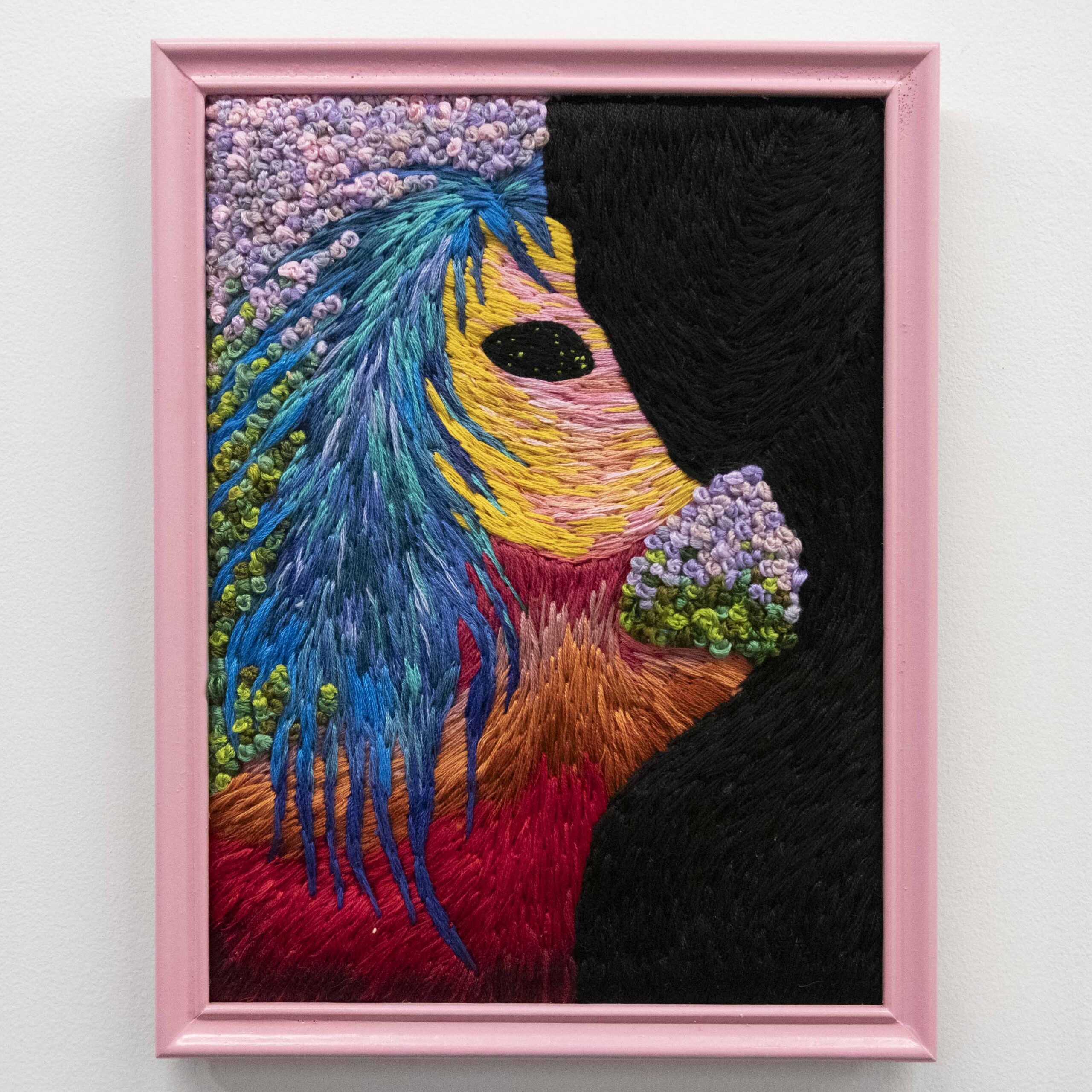
burnt up in the nothingness, embroidery thread on calico fabric (framed), 217x167mm, 2025
Tell me about the titles, where have they come from? Your exhibition title ‘I’m somewhere else now’, does that hint at a kind of escapism you’re offering?
Another thing I was really interested in last year was near-death experiences. I was reading about what people experienced on the other side and these other dimensions that they went to. How they talk about these realms, how they’re indescribable and how it’s more real than real life, that there are colours that don’t exist. But what really struck me, and was repeated across multiple stories, was that, if you ever feel like you’re lost, there is always a silver cord that you can follow to find your way back to safety. I was struck by that image of the silver cord. That comes into one of the titles.
Have you had a near-death experience yourself?
No, I know I’m still young, but when I turned 30, I became more preoccupied with death and spirituality in a way I hadn’t been previously. I wanted to address these areas of life and thought that I hadn’t had much space for before, which lead me to that area of research.
Putting death out there can put a different spin on everything. It puts a new interpretation on some of the scenes.
Everyone seems to go some place slightly different in their near-death experience. I was interested by this idea of indescribable dimensions, floating in a void space, and there being no concept of time. Or seeing yourself in a parallel dimension. One man talked about seeing dog-headed figures, which I thought was interesting as that’s a figure that appears in my work a lot. I know near-death is not death, but still I’m interested by whatever these experiences are.
Do those experiences come out in the imagery of your artworks?
Yes, I think so. In the work ‘there is always a silver cord to take you home’ I was looking at this river taking you somewhere, it’s a barrier between one place and another like the River Styx. The colours are dark and mysterious, the strands at the edge indicate plants but aren’t concretely so. And in ‘in faraway orbits’ there is this procession of figures walking into a strange dimension. In the work ‘burnt up in the nothingness’ the figure is kissing a black void – there is an idea of addressing the unknown there. Maybe this is what the show is all about Cameron, death and other dimensions!
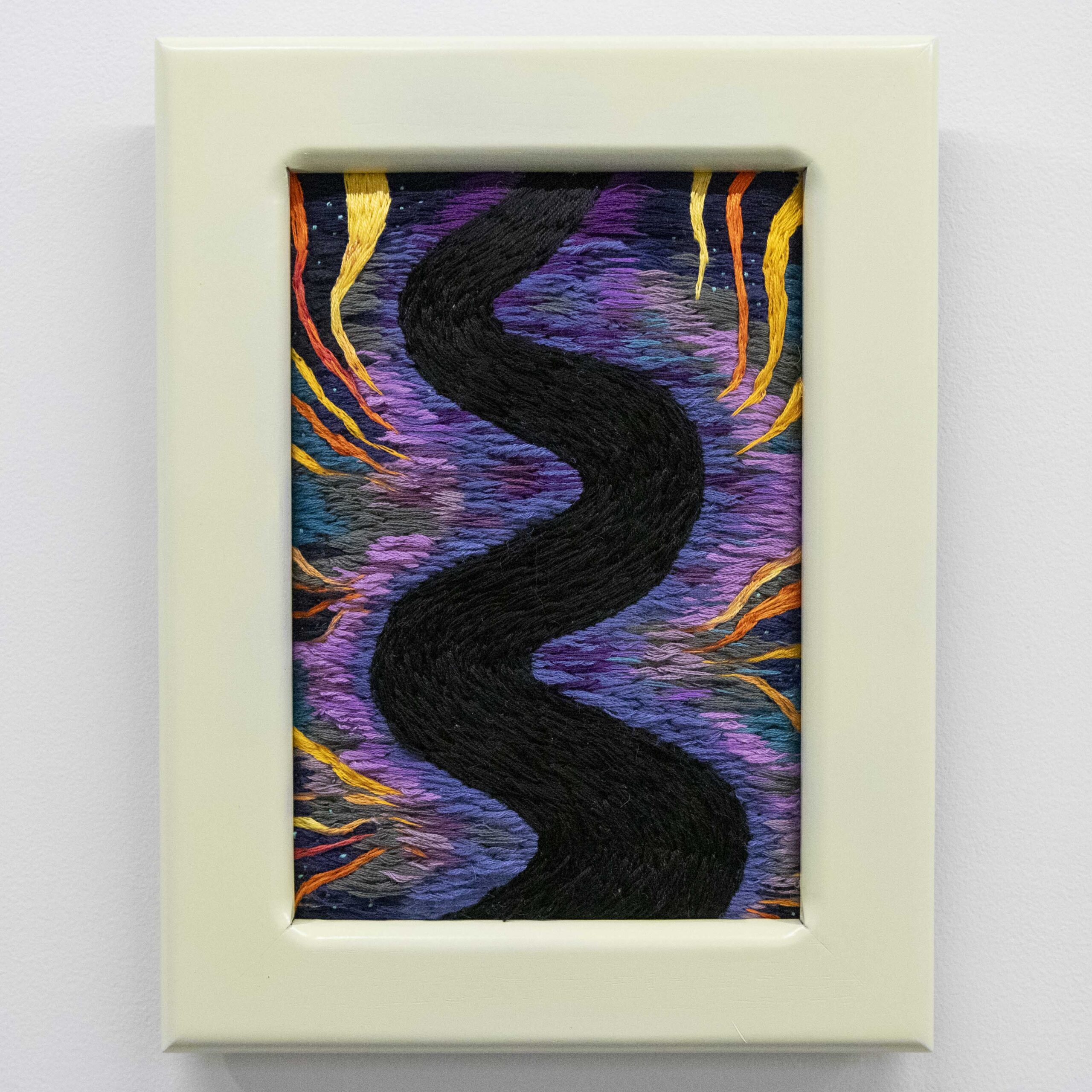
there is always a silver cord to take you home, embroidery thread on calico fabric (framed), 227x174mm, 2025
Previously we talked about your use of colour in relation to Rudolf Steiner’s theories. Are you applying that here again?
It’s definitely still there because theosophy is linked to Steiner, and I’ll always have those colour influences from my childhood. The colours I’m using are rarely ever pre-planned – I will just pick then intuitively as I’m embroidering the pieces.
I think there is some marriage between the medium that you use and your subject matter. It brings a comforting element to the body of work.
I try to do that intentionally. I wanted to make something magical and comforting. You look at all the images together and create a feeling of a certain world or space.
Have you changed anything about your needlework for this show? Are you still using the same techniques? The tiles on the house roof are particularly impressive.
I spent a very long time on the roof tiles of ‘white moon flowing, she’s asleep’. And I’ve used the French knots again which I’ve only used once previously. I’ve also been thinking more about the directions of the stitch work. For example in ‘in strange orbits’ I’ve made the sky slanted one way and the cone going upwards then the ground stitches going straight across. It creates this interest in the composition with different flowing movement.
In your artworks, in that cosiness or lightness, these mystical or difficult to understand parts of life become more approachable.
That is nice to hear. I really do struggle with this every time to know exactly what my work is about. I feel like other artists are very good at that, pointing to specific parts of their work and practice.
I don’t think that’s entirely true. I think your work takes on abstract ways of making. Through your making you land at a place which has some meaning. Perhaps sometimes that meaning isn’t immediately obvious and it’s okay to open that out to abstract thought. It’s not always necessary to explain what figurative work is about. Meaning can seep out of a work after it is made.
I often think about this Agnes Martin documentary I watched, ‘With My Back to the World’. She went and lived like a hermit in the desert for decades. She talked about how she had to unlearn everything she’d ever known in her whole life in order to make the artwork and be fully connected to it. Letting go of everything she’s ever conceived. I don’t think you have to go that far, but I found the idea interesting.
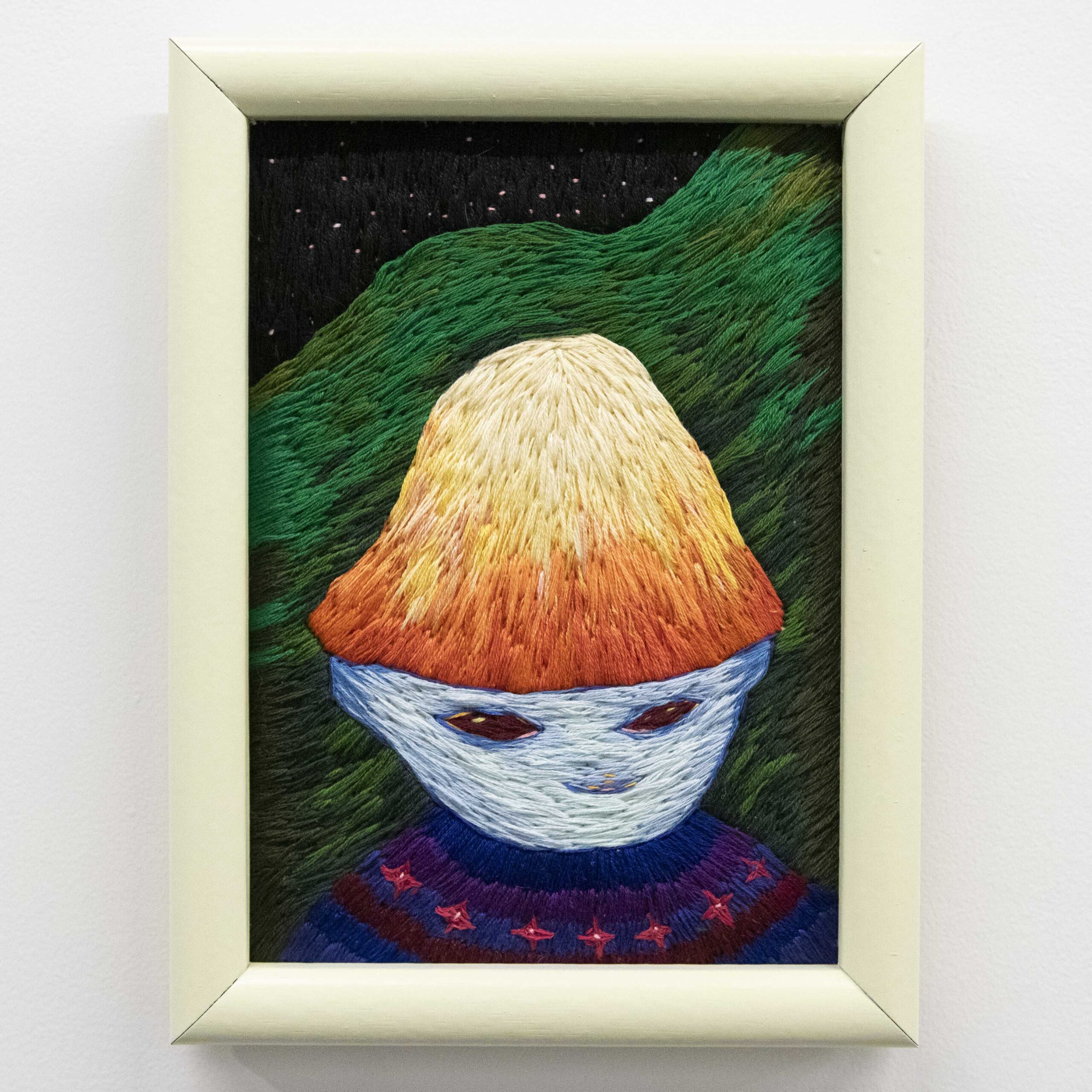
walking walking until a small nothing, embroidery thread on calico fabric (framed), 198x148mm, 2025
Are there any specific artists that you find you’re influenced by or return to often?
I always used to reference Van Gogh and other post-Impressionist painters. I was heavily inspired by their compositions especially. I also look at contemporary Japanese painters quite a lot. Because they often will have cartoon bunnies featured in them alongside intense colour palettes and a whimsical, child-like way of making art. Yoshitomo Nara is one artist who uses a very iconic figure in his work, as well as Ayako Rokkaku. I think you can see that influence in the figure in ‘walking and walking until a small nothing’. I’m also continually drawn back to Agnes Pelton and Nicholas Roerich who are two spiritualist painters from the turn of the century.
Do you think your works have a sense of humour or joy?
I think there’s definitely a levity to them that you can tap into! Once a woman who’d bought one of my artworks told me she had it hanging near her bed and every night she hoped it would give her strange dreams. I loved that.