In Ōtautahi Christchurch-based artist Saskia Bunce-Rath’s significant new body of work the artist’s experiences of nature as viewed through the filter of modern life, are recorded in vivid needleworks. Ahead of her exhibition now that I’m listening, it’s deafening, City Art Reader editor Cameron Ralston spoke with the artist. now that I’m listening, it’s deafening opens on 5:30–7pm Tuesday the 8th of September 2026 at City Art Depot. Saskia will also deliver an artist talk at 1pm on Thursday the 10th of September in the gallery.
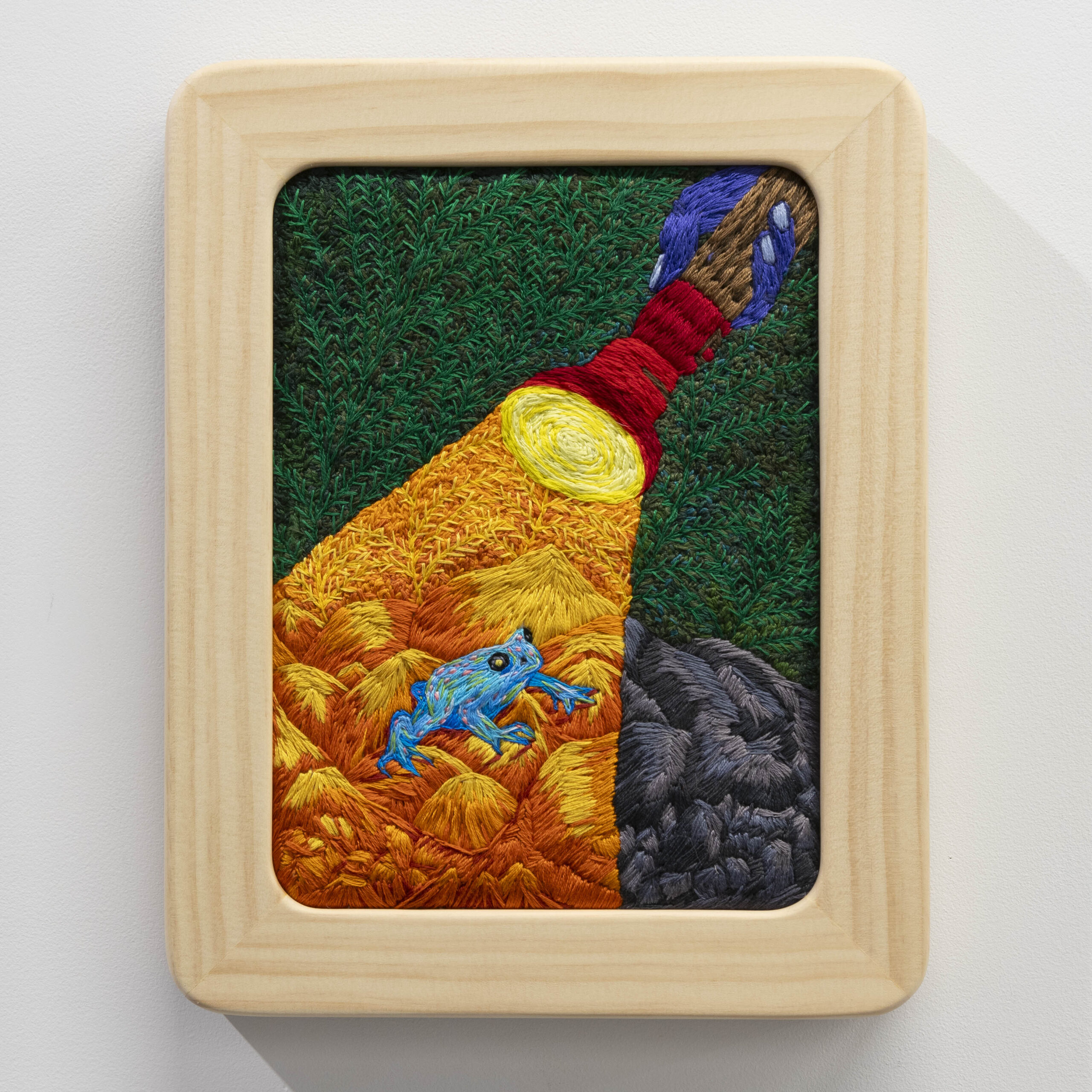
a glow radiates over the faraway hills and shadowmean wander the pathways, embroidery thread on calico fabric (framed), 261x208mm, 2026
Cameron Ralston: You’ve made a departure from your previous work with this exhibition. Yes, the medium is the same, and there is that element of whimsy, but it’s more familiar, human. Has there been a conscious shift in your practice?
Saskia Bunce-Rath: Yes, I’ve made a very intentional departure from what I had been doing before. Clearly there’s a lot that’s still the same, but I had begun to feel trapped in the characters and motifs of the landscapes I was creating previously. I wanted to challenge myself to expand my visual language and technical skills.
What do you mean by trapped?
Trapped in my own symbolism. It wasn’t resonating with me at all. For me an artwork will often arise in my mind, sometimes many different images and ideas all at once and I no longer had any images of the previous worlds I had created. Everything had started to feel a tiny bit hollow.
I think these new artworks are perhaps more explicitly personal than my previous artworks have been. There was a demarcation before, this is my artwork and it’s separate to my life. But in this show, I see a lot of refences to my life or things that I have consumed or things that I have been thinking about in a more apparent manner.
I’ve also been watching documentaries and reading books about artists and their practices, and I found myself very drawn to how the artworks connected to the artists’ personal lives. I wanted with this body of work to create a level of connection to this point of time in my life, something inside me felt very drawn to document this past year as it feels this period in my life is a doorway to somewhere.
There are different schools of thought on whether it’s necessary, or interesting, for people to have that kind of personal insight into the work. I think it can be an interesting extra layer to add. Would you feel comfortable people knowing what you reference in your art?
Yes, somewhat… I remember last time we discussed this I said I thought it would be uninteresting to know the personal symbolic minutia of my artwork. But maybe some people would find it interesting!
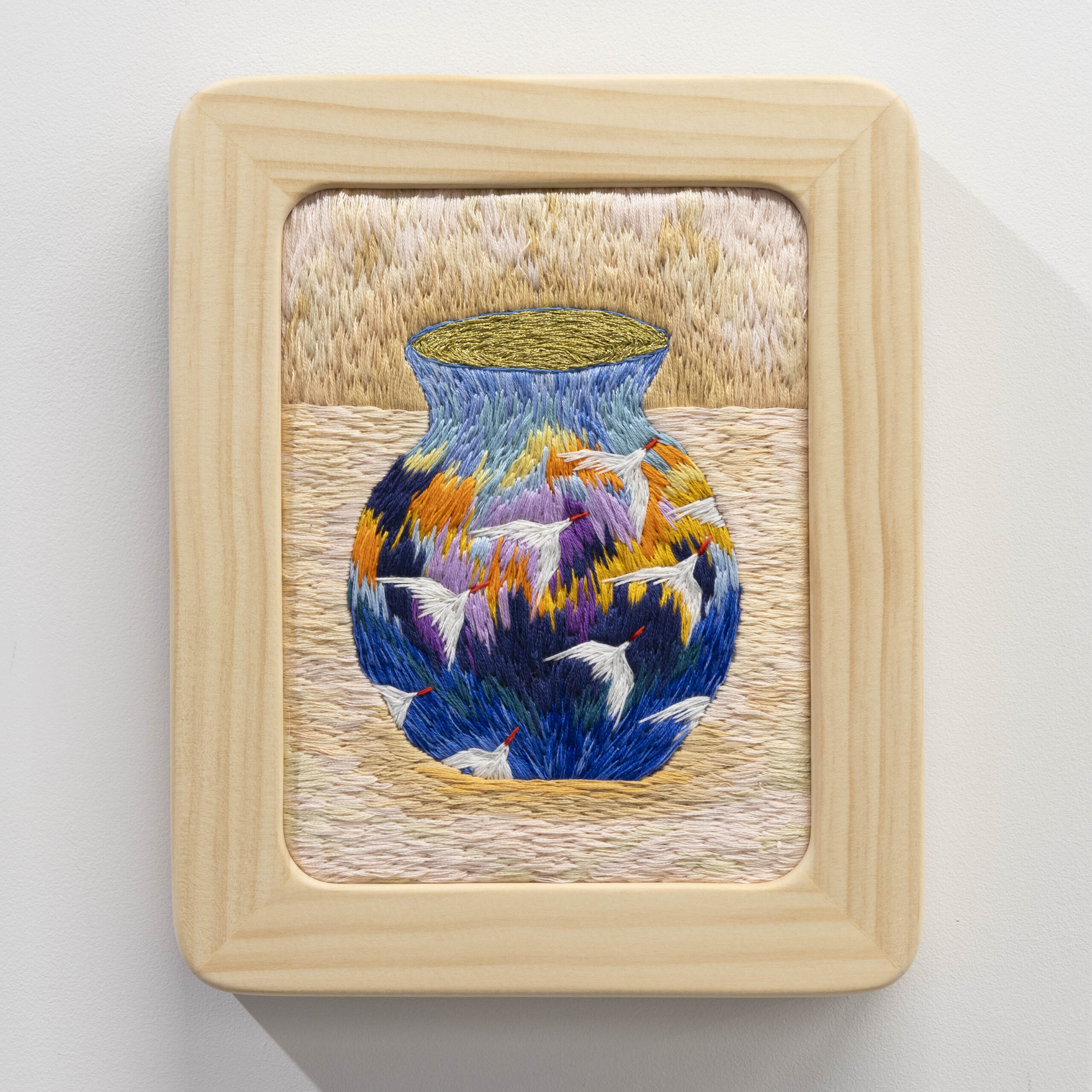
in the evening the birds are loud, I lie in bed and listen to them through the walls, embroidery thread on calico fabric (framed), 239x196mm, 2026
For those reading this, it probably is.
They might be curious. For instance, this artwork in the evening the birds are loud, I lie in bed and listen to them through the walls I find amusing in a way. It’s based on a sketch of a pot I planned to make whilst doing an art residency at Driving Creek Pottery. I found pottery a difficult medium so I’ve made an embroidery of a pot instead of the physical object. There is humour in this disconnection and connection, and also a tender appreciation for an object that only exists in idea and now thread than how it originally was meant to be manifest.
I think I talk about this every time, but a lot of this exhibition is informed by my climate change dread, that’s what the show title is about: now that I’m listening, it’s deafening. Which could mean anything when you first read it, there is ambiguity there – what are we listening to? Without knowing what I intended with the title you would have conjured an idea of the sound I’m talking about whether metaphorical or otherwise.
I watched a documentary, Time and Water, at the film festival recently, which is about an Icelandic writer who had been tasked to write a plaque for a glacier that’s completely melted due to climate change. The film is visual letter to a future that he’s not even sure is going to happen. I was contemplating a lot of similar things creating these artworks, the knowledge that so much of the natural world is dying, that we are living through a human made mass extinction that has killed countless species of animals and plants and could potentially kill billions of people in the future as well. A big part of these artworks is documenting life and nature in a world that feels like it’s slipping away.
You know, nature’s still present in these artworks, but less primal, sort of oddly distorted. Behind the figure with the phone, under the house on the hill, horses on a movie screen.
Yes, the horses on the movie screen were in reference to a Werner Herzog documentary Cave of Forgotten Dreams which is about the Chauvet Cave in France which has some of the oldest cave paintings in the world, some of them dating back 32,000 years. I was particularly drawn to the horse paintings, the energy and movement of them. Watching the film I was overwhelmed by the idea of these artworks connecting to me through this huge wealth of time. And then I was making an artwork that’s looking at an artwork but viewed through a screen. There are these layers of separation but also connection.
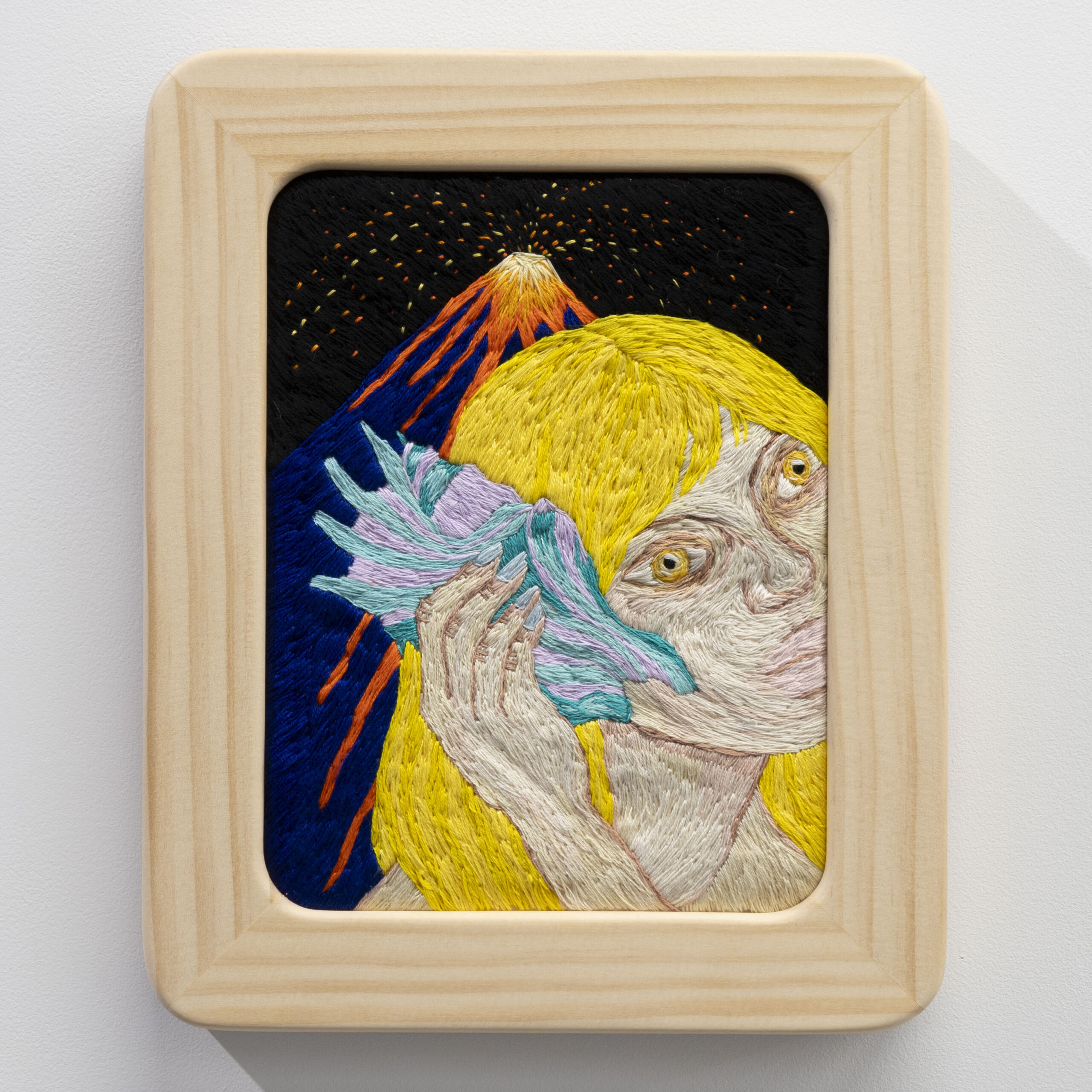
now that I’m listening, it’s deafening, embroidery thread on calico fabric (framed), 240x197mm, 2026
Are you so often influenced by film?
Recently, definitely. My work now that I’m listening, it’s deafening was another. I didn’t even realise until I finished it, but it’s very similar to a shot from this documentary, Fire of Love (the same documentarian as Time and Water, Sara Dosa), which is about a volcanologist couple who died together in a volcanic eruption whilst conducting research. There’s this shot of Katia Kraft holding a rock to her ear which is reminiscent of the woman in my embroidery. When creating the image I decided to put the volcano in the background and it suddenly occurred to me, it’s just like that image of her, it must have penetrated my mind at some point.
Then with this work, this is where I dream, always of the tall gum trees, when I was making it and I thought oh! it looks just like my studio-mate Christiane Shortal. And she also said she’d looked at what I was making and wondered, ‘Is that me?’, which was an unintentional but charming thing to happen, it felt serendipitous. It’s also inspired compositionally by the Andrew Wyeth painting Christina’s World of a woman on a desolate hill looking up towards a house.
I’m interested in how you arrive to an image. Previously you’ve mentioned how they emerge to you and you were even attempting to draw them out through meditation.
Oh yes! That’s one of the most rewarding and interesting parts of art making for me, this connection to an almost spiritual, ethereal, artistic realm. You’re not even sure how these images are arriving to you, but they do. They come into your mind. Like this one, we forget, sometimes for years at a time, I made of an image I saw vividly in a dream. In the dream there was this immensely blue vibrant light and an archway formed around it with glowing stars. I drew a sketch of it as soon as I woke up. Sometimes these dream artworks stay with me for years and I keep on trying to create them because I can never quite capture the essence of what I experienced.
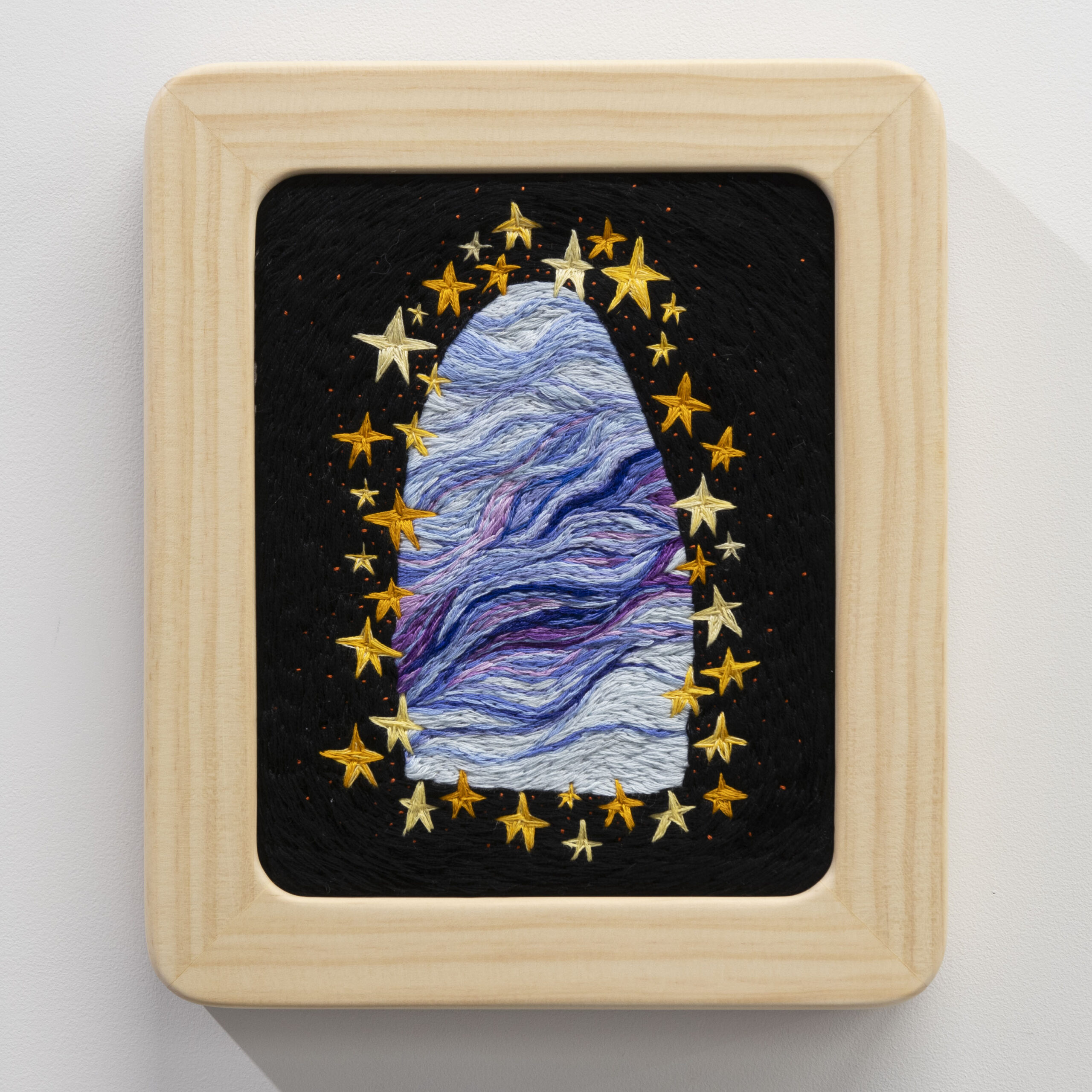
we forget, sometimes for years at a time, embroidery thread on calico fabric (framed), 249x211mm, 2026
Do you consider ethics in the way you make art?
It’s certainly something I consider; I try and contribute as little as possible to waste and buying unnecessary new things. All of my art materials are sourced secondhand where possible. When getting these framed with you guys instead of using opshop frames like I have done previously we discussed using natural materials and wood stain that is environmentally friendly. I’ve also been having lots of discussions with friends about generative AI and how damaging it is environmentally, ethically and artistically. I think art, craft and taking a long time to make something are important human experiences; the struggle of creation is where your experience and understanding of something truly expands. Outsourcing artistic practice to something that runs off of stolen intellectual property is wrong, in my opinion.
What was the Driving Creek residency like, you mentioned you found pottery a difficult medium?
It was interesting, it’s such an incredibly beautiful and special place. Originally, I had intended to just work in my own medium, but being there surrounded by so many people who are deeply passionate about pottery and having access to all of these resources, I made a series of four hand built vases. Throwing myself completely into another medium I had no real experience with made me reassess my relationship to embroidery and textile mediums in a way I hadn’t before. I realised that I truly have a deep love and connection with embroidery and textiles, and I want to continue dedicating my time and life to creating my own personal mastery of it.
It inspired me to read more about embroidery as well, its history, its place in so many cultures across the world. One of the books I read was about medieval embroidery and all the women that worked in these embroidery workshops in England, the Opus Anglicanum embroideries. They’re just incredible. Knowing that I’m using the same stitch style as these women makes me feel connected to a lineage of women who perfected a skill that often was their only means of liberation.
However, I do sometimes sense that people are less excited about embroidery than say, painting. There do seem to be some biases around it still.
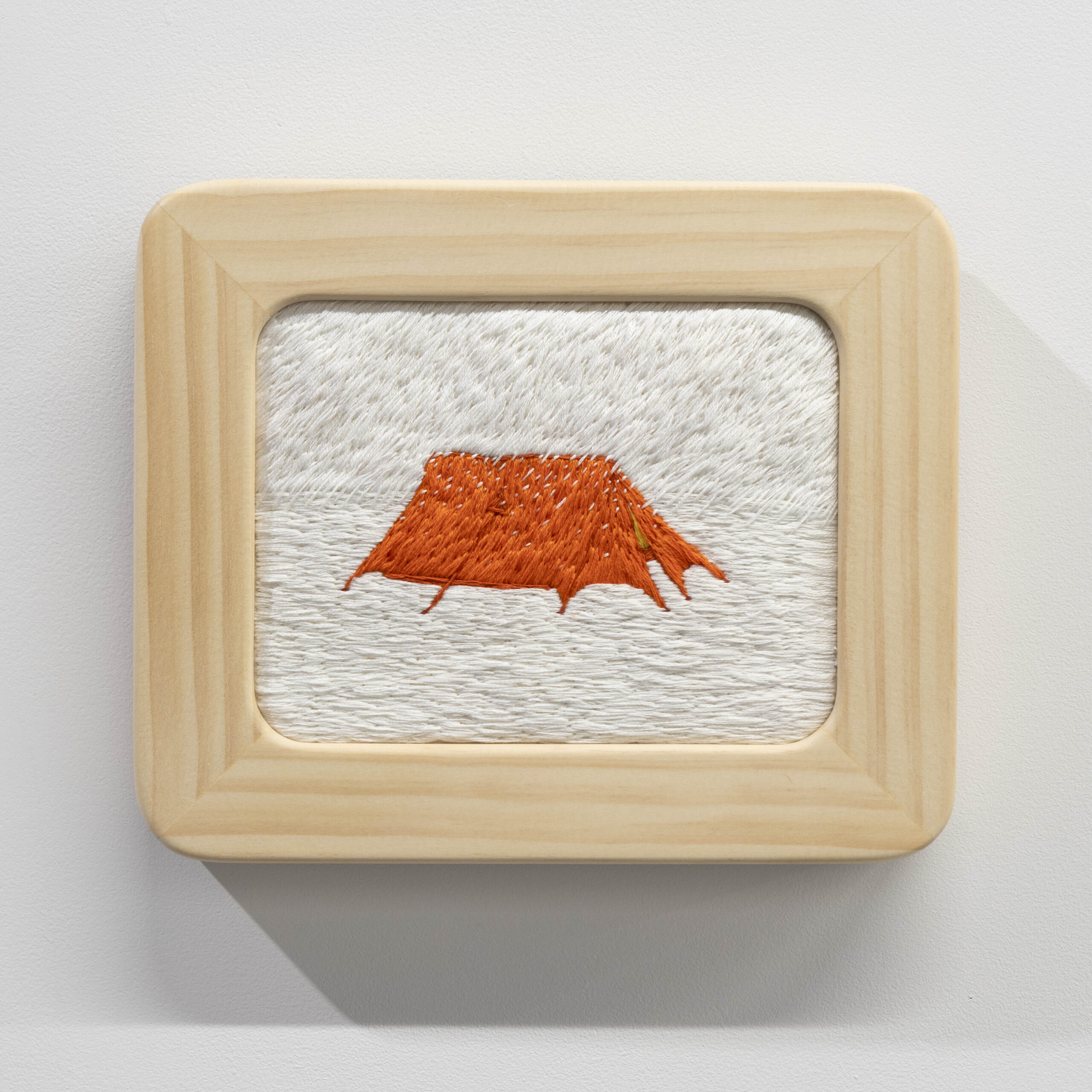
grinning and grinning at the moon as it passes me by, embroidery thread on calico fabric (framed), 168x202mm, 2026
I think your work is a good example of how any inherent hierarchies of medium doesn’t dictate good artwork. There’s something different or original to the way you make an embroidered artwork though. There are considerations and an attitude to the way you create your art that elevates it.
It feels different when I’m making it as well. I’ve taken up knitting and it’s really fun, I enjoy knitting a jumper and creating my own design. But it feels different. Making these artworks feels more expansive in my mind. Like I’m connecting to something in a way that I’m not when I’m doing what I designate in my mind as a craft.
In doing the Driving Creek residency I had this this moment where I was like, I love it. I love even the frustrating parts. And I want to keep going and see where I can end up. So, a lot of these artworks have imagery I’d previously been too anxious to attempt, or I thought that I wasn’t capable of capturing in embroidery. People, humans, the house with all the windows.
Going back to the fine art thing, and I’m sure you feel this as well, sometimes you look at a piece of art, and there’s something in it that’s speaking to something in you, it’s an invisible conversation between you and something in the artwork that you deeply recognise. That’s what makes people want an artwork, right? A need to see and feel that thing every day, to be reminded of it, because often it’s something you had forgotten or lost. There’s something inexpressible. That, for me, is why I return to art and continue to make it.