Ahead of Clutter, an exhibition of new work by Lyttelton artist Lisa Patterson, City Art Depot gallery manager Cameron Ralston visits the artist in her long suffering employer’s studio, which she has once again appropriated as the exhibition date rapidly approaches, tucked in an old building in Linwood.
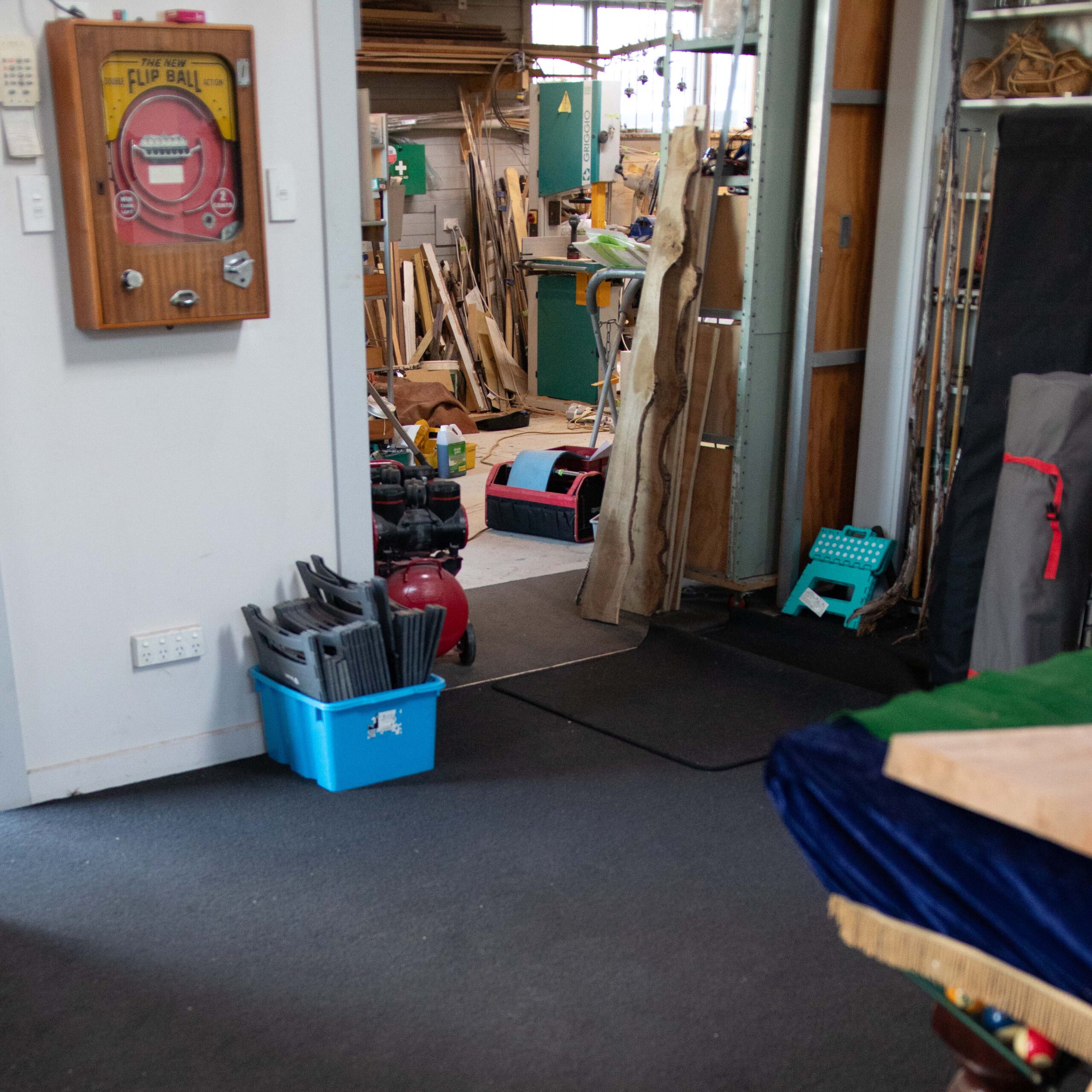
Lisa Patterson’s appropriated space joins on to a large room with a bar and pool table. In the workshop, a chaotic fare of machinery is surrounded by offcuts, sawdust, odds and sods. Tak the dog follows Lisa around while her partner Al fashions himself a new belt (Lisa acknowledges Al’s contribution to this exhibition, both in his inability to cope with her clutter, the subject of this show, and in his practical skills in helping make some of these works).
Lisa Patterson: Basically the show is to do with clutter. All this stuff around here, in all the corners of this building, is mine, mostly. There’s stuff that I’ve secreted away everywhere, and – you’ve been to my house – there was probably stuff leaning in all the corners there as well. And now, since the start of this year, I’ve had Al and his two daughters and Tak move into my house. Al doesn’t like clutter and neither do I but I’m terrible at actually dealing with it. It just shifts around, not to the places it’s supposed to be. So I was thinking, about clusters on the gallery walls and things in corners. It’s not a cluttered show, it’s a spare show, but it’s about clutter.
In the entry way to the workshop a collection of pool cues rest, some in their designated holder, others haphazardly lent against shelving. Lisa shows me a sturdy oak base with routed holes and a collection of sticks leaning into a clear corner of the workshop.
The base for these is modelled on those pool cue racks, with the holes in the bottom where you’re supposed to situate them. It’s organised, but not really. I’ve got my hoards of manuka sticks and stuff that I lean in the corner – things that I can’t throw away in case they are useful. It’s looking like it’s a jumble but actually this is custom-made – it’s a vaguely organised chaos.
Nearby, a timber branch protrudes out from the white wall.
This is an oak branch which is having sticks come out of it – an idea I’ve ripped off a drying rack by the fire Al fashioned at home. I’m using lots of these sticks and kind of semi ordering them.
Recycled materials, with personal connections, are an ongoing characteristic of Lisa’s practice. She shows me chunks of scorched looking timber from a tree from the Craigieburn area where a fire occurred in December 2024. An oak plinth sits on the floor, made from the same tree which formed much of her 2023 City Art Depot show In Defense. Protruding from it is part of an apricot tree. Her artworks share an attuned sensibility to the interplay of refinement and the natural states of her materials.
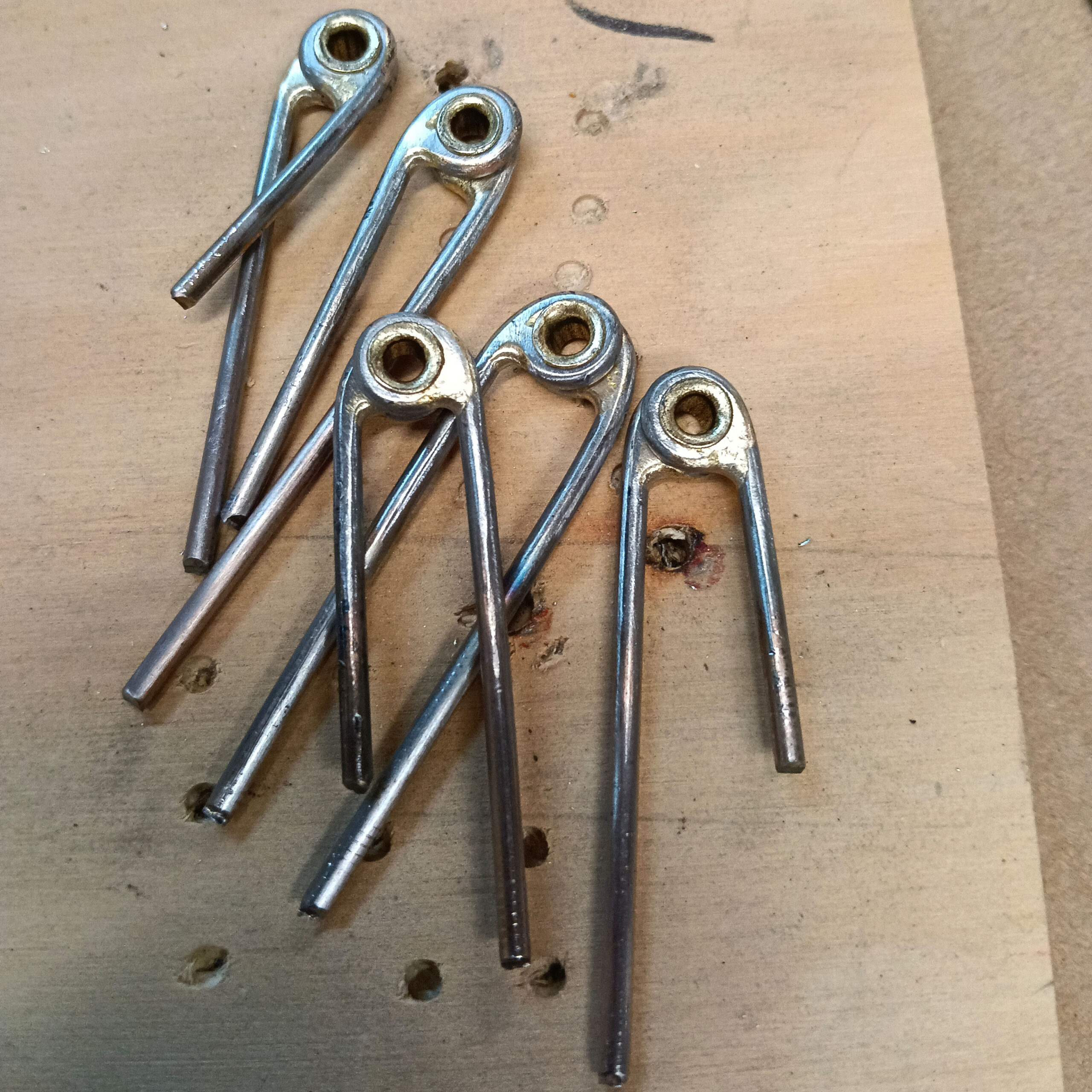
Lisa’s artworks are often loosely functional or inviting to touch. Artworks made from the old oak tree have crudely crafted bespoke hinges, inviting the viewer to open the doors and reveal their secret interiors.
It’s like trying to condense stuff, shut the door on crap, but most likely failing, leaving the doors open. When you shut it, the piece becomes a simpler, tidier thing.
That notion of concealing and revealing continues as we discuss her use of lead.
The sheet lead is kind of like throwing a cloth over things to conceal them. Draping over the wood like fabric. Before we’d even met in person, Al sorted out for me all this lead that they were taking off huts on the Coast because of the keas. I’d said, what are you doing with it? You can’t say no to lead. I used to work as a leadlighter, so I’ve always liked working with it. But even before that, there’s something nice about how malleable it is.
Being in conversation with her materials is a source of joy for Lisa – a sense of pleasure and perfectionism in the craft that comes across in the finished works.
I want it to be fun when I’m doing the work. You see some people’s work and you’re like, ‘Oh, that just looks like it’d be great fun to do.’ When I first started making those crudely hinged artworks, I thought it was awesome. I’d make about five of these a night. But then I’d have that terrible feeling of, ‘Oh, not finished, it’s not my good copy – it’s like a study or something’. Then I started getting more complicated with them.
Colour in Lisa’s artworks is typically reflective of the material itself, be it timber, lead, gold leaf and wax, while the materials themselves are finely shaped and carved. It was surprising then when a hinged artwork was opened to reveal some sketched out drawings.
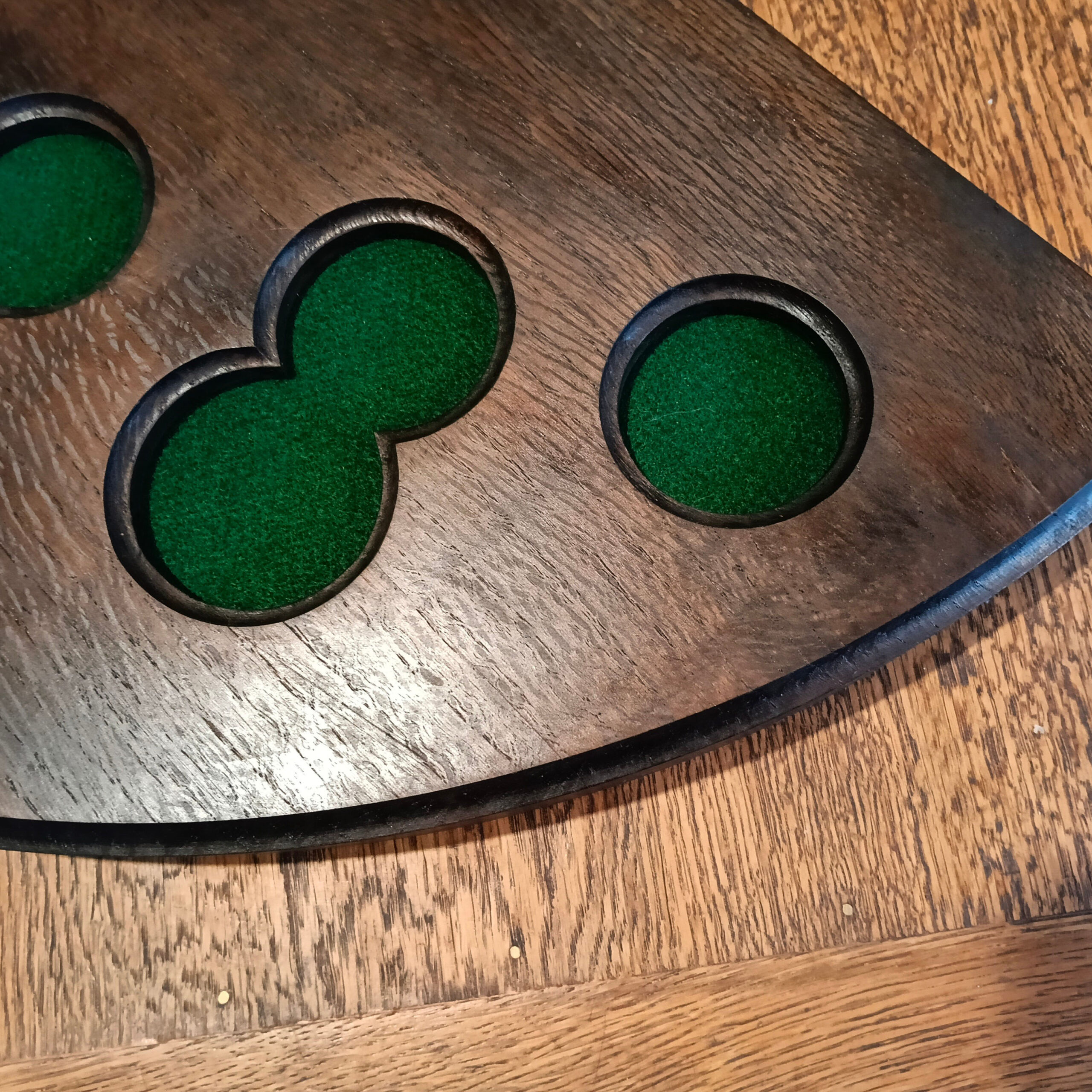
I think drawing is the same as colour for me. I think I can’t deal with it. It’s useful enough. Like those green pool table fabrics – that’s a specified color, I don’t have to make a decision on that. So basically, the drawing is probably just going to be drawings of other sticks. So not too detached.
An exhibition opening looming in a couple of weeks might typically cause concern, but for Lisa much of the work is in the ongoing process of collecting, sketching, a coming together in these final moments in the studio. Whittling away the rough edges, condensing an idea until it comes to a stronger conclusion.
My work gets run fully up right at the end. I seem to find it impossible to make one thing and finish it and move to the next thing. Or if I do finish it, I think no and kind of cast that idea off because it’s not relevant anymore. I keep having new ideas. Al would tell me to finish the idea you had a few weeks ago but it doesn’t necessarily work like that. If I finished a show early I’d still be wanting to do more. I was thinking the other night that I’ve been having exhibitions for 25 years and I possibly do know what I’m doing.
Previously Lisa had made work about her home and the conflicts that happened with neighbours. I’m told her attention has since shifted – she appreciates, she says, how none of her neighbours have kicked up a fuss over her ‘inconsiderate art making practices’.
I think I’ve gone a bit more inward trying to get rid of things. Now I’ve got a storage unit because I had to make room, which is really bad. My plan was, while I did this show and I was thinking about clutter, I could also go to the storage unit for an hour a week and get rid of some of the stuff that I just dumped in the room in a panic. But of course I haven’t stepped foot in there. It’s hard to get rid of stuff. Hopefully I’m getting rid of the couch out of the storage unit this afternoon – that’ll give me a couch worth of space to fill up with something else.
Even though I call it clutter I find the potential and meaning in things. You can guarantee within a few months of getting rid of something, I’ll think that it’s time now and now I don’t have it. So I have used a small amount of my clutter in making these works but probably since I started I’ve also added a lot more clutter to the general resource pile.
And what does she think her show will look like?
In my head it’ll look like home.