Ōtautahi Christchurch-based painter Francis van Hout crafts geometric abstractions with adept sensibilities to paint materiality, colour and surface texture. The initial structural seriousness of these works as viewed on screen or print doesn’t translate the grain, quality of line, warmth and wit within the paintings. Grey, Red (Getting Older) opens 5.30–7pm 26 May and runs through to 22 June 2026. Ahead of this Cameron Ralston joined van Hout in his studio to discuss the new body of work and living with paintings.
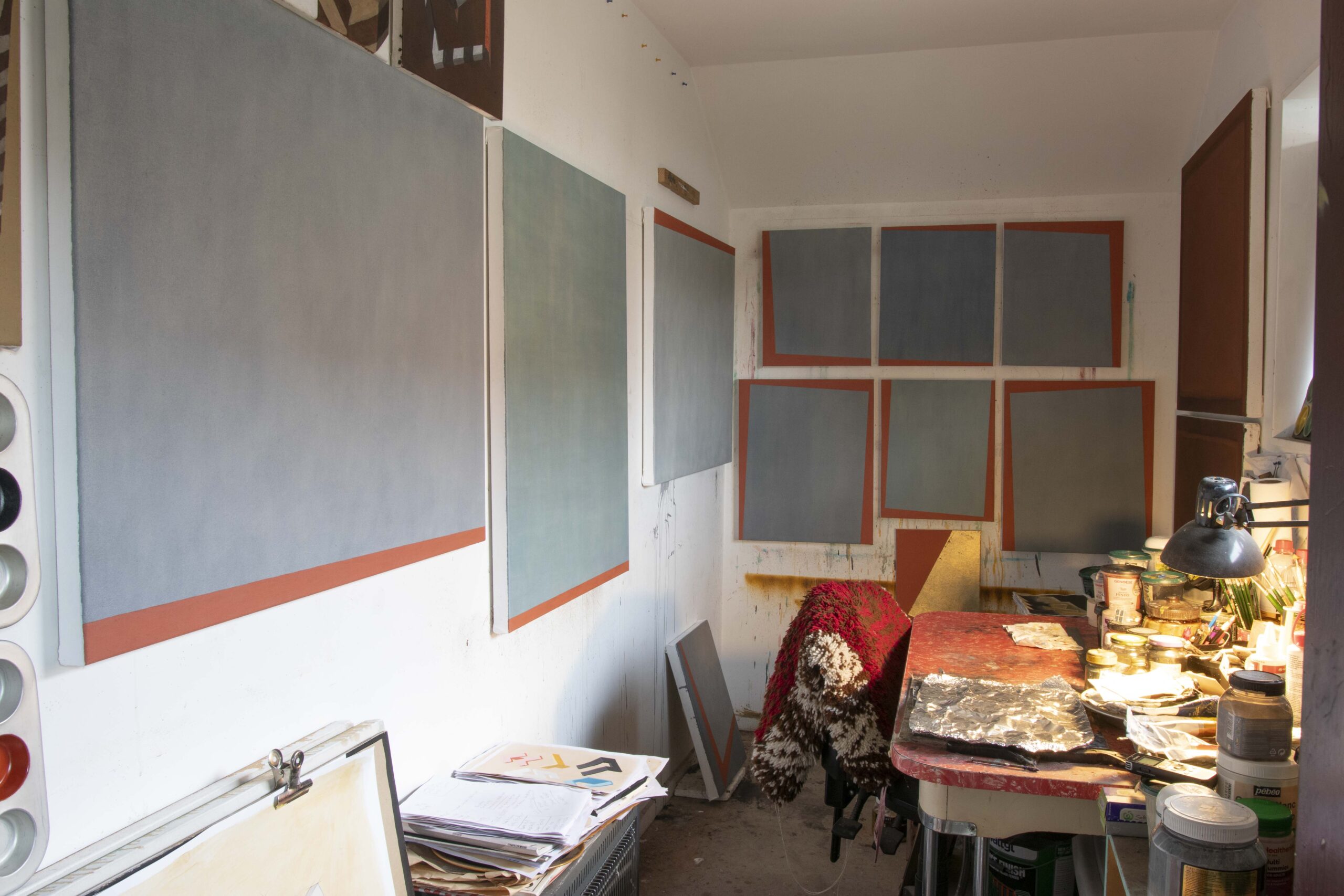
Francis van Hout’s painting studio
Cameron Ralston: So, these works all began as drawings?
Francis van Hout: Yeah, lots of drawings. As a way of figuring it all out. They started off as threes.
What makes you choose one design over another?
Just what looks good. I painted all these and they were just sitting on the walls. I wasn’t satisfied until I took them down to photograph them, put them in the computer and started playing around with them. They’ve changed a lot, even until yesterday.
What is it about the computer? Is it just being able to stand back?
They’re smaller on screen, so you’re standing back from it. But as well, I think I had the titles with them. And the title of that painting was up hill. So, I turned it upside down, which emphasises it and makes it a bit funnier. It relates to the show title ‘Getting Older’. It’s like an uphill battle or a downhill slope. Those little tweaky things that I think about became the title.
Are you jabbing humour at yourself getting older?
Yeah. I’ve been feeling it. I injured myself last year. But that’s not the true reasoning behind the works. Working towards this show started out as a look at the shape and form of townhouses and their development in Christchurch. So I started off with what I call the ‘Architectonic’ works. I produced a whole series of drawings on those, then they were sitting up on the wall and I probably overexposed myself to it. I basically thought they weren’t developed enough to put a show on. I was joking with a friend online about the Architectonic works, that maybe I should throw them away and just do grey paintings, because I had an artist’s block, like a concrete block. So, I did a grey painting.
Was it purely grey?
It was just purely grey. And then I did another one and began to think what else I could do with the grey. The grey related to that old age thing I had been thinking about. That was probably why I stopped working on the Architectonic works, because I was feeling a bit old and jaded, a bit grey. Then I remembered that I had done works like this in 2018, which were my grey and red works.
What were you thinking about back then?
I think it was more to do with battleship painting, something I often revisit in my work – in that case it was the grey and red. I was working with those colours in one of the magazines I was painting on – this one a Physics Room Hamster magazine, filling it with works. So I picked this back up and added the red – it’s really nice to go back and have that connection to some works I’d already done.
Your 2019 exhibition at City Art Depot Green Field, Grey Field also seems to have a strong relationship to this new body of work. They were also presented as diptychs.
Yes, I was referencing back to those works. But they were different. They were more to do with the presence of ‘grey fields’, a term used about gravel parks between buildings after they knock them down. I was thinking then about how our spaces became green fields and grey fields after the earthquakes, after knocking all the buildings down. But they also had references to bunkers, looking through bunkers, living in bunkers.
You’ve started here at a similar point – looking at architecture and changing landscapes within the city, townhouses being the latest thing sprouting up all around us?
Yeah, and taking the green spaces away and putting grey spaces back in. You could look at these works as well that way. A lot of my abstract work, I call them the slab works, started when Christchurch began to be rebuilt with grey concrete slabs. I think maybe that’s subconscious and always in my head.
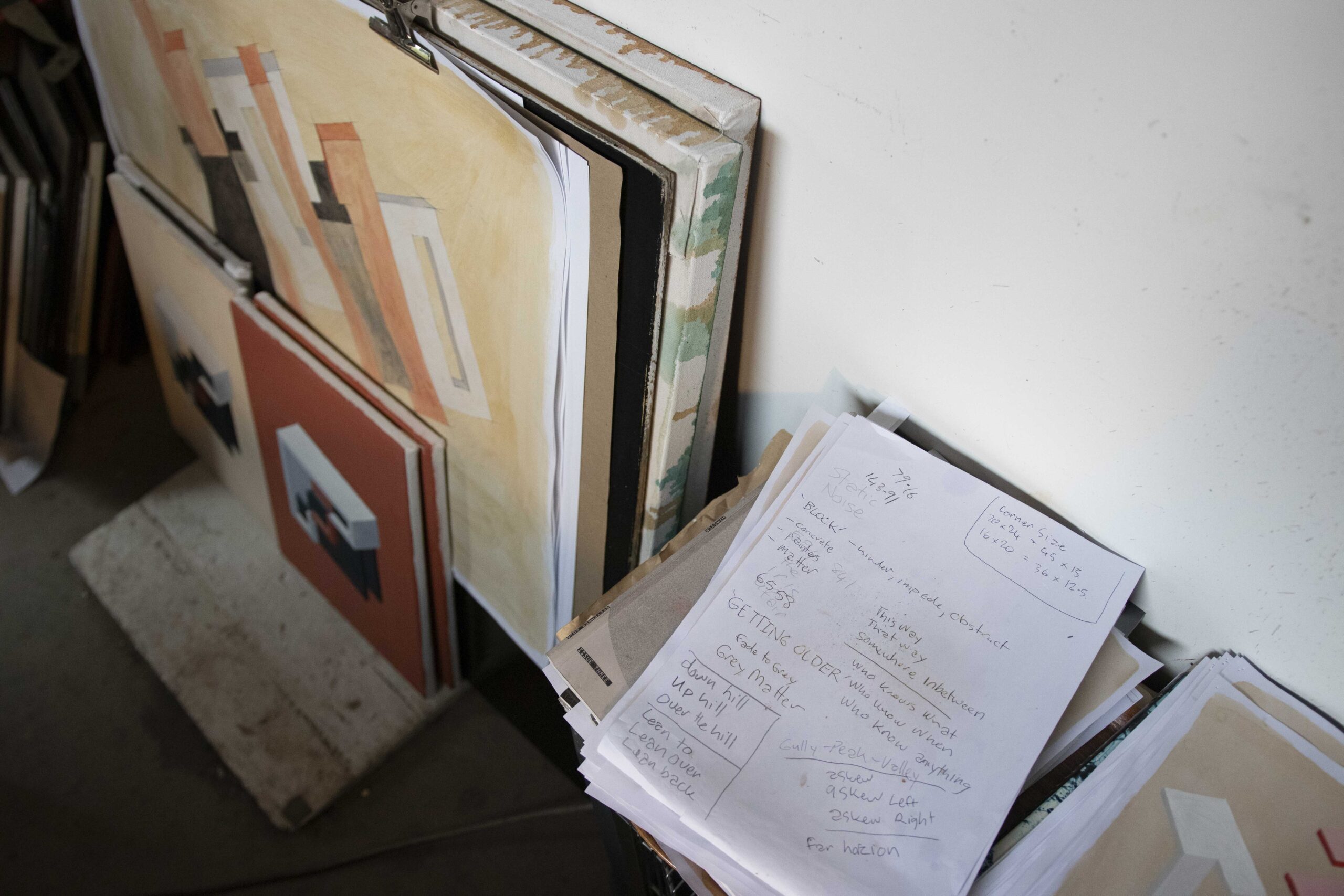
Francis van Hout’s painting studio – title ideas and Architectonic studies
Some of these paintings could read as landscapes. There’s potentially a horizon line in there.
And archways. Or gaps, as I call them. One of the titles is ‘lean-to’, which references a lean-to garage. It depends on if and how you read a title, and then how you look at the artwork.
And on how literal you go?
I take the titles more as fun. You know, this gap and that gap. But they do have references to things around getting older as well. You want a bit more space around you as you’re walking, because you lose a bit of balance, or you start to lean around a bit more. Your eyesight starts going a bit funny, you start to see things a bit greyer. There are more aches and breaks in your body, shooting red pain. But then, you could look at them as landscapes. Grey sky, fiery red ground. Don’t take me too literally.
How did you develop the colour and texture across the paintings?
The works were always going to be grey. I did experiment with adding some acrylic washes. There’s a lot of yellow on them because I wanted them to age a bit more. As I mentioned before, there are memories of what I’ve already done and memories of seeing pictures of battleships with their grey and red. Perhaps it’s something I’ve grown up with, but you’re always going to put red with grey no matter what, because it works so well.
When I started with the Architectonic works there was a lot of colour, but it was the very primitive colors – greys, blacks, reds and whites. Mainly because I’ve been using those few colours for a long time now.
In recent years you have been using homemade pigments in your paintings.
In this case I’ve purchased powders, and I still make up the paint themselves by using acrylic binders. So I’m still working with those kinds of elements and colours.
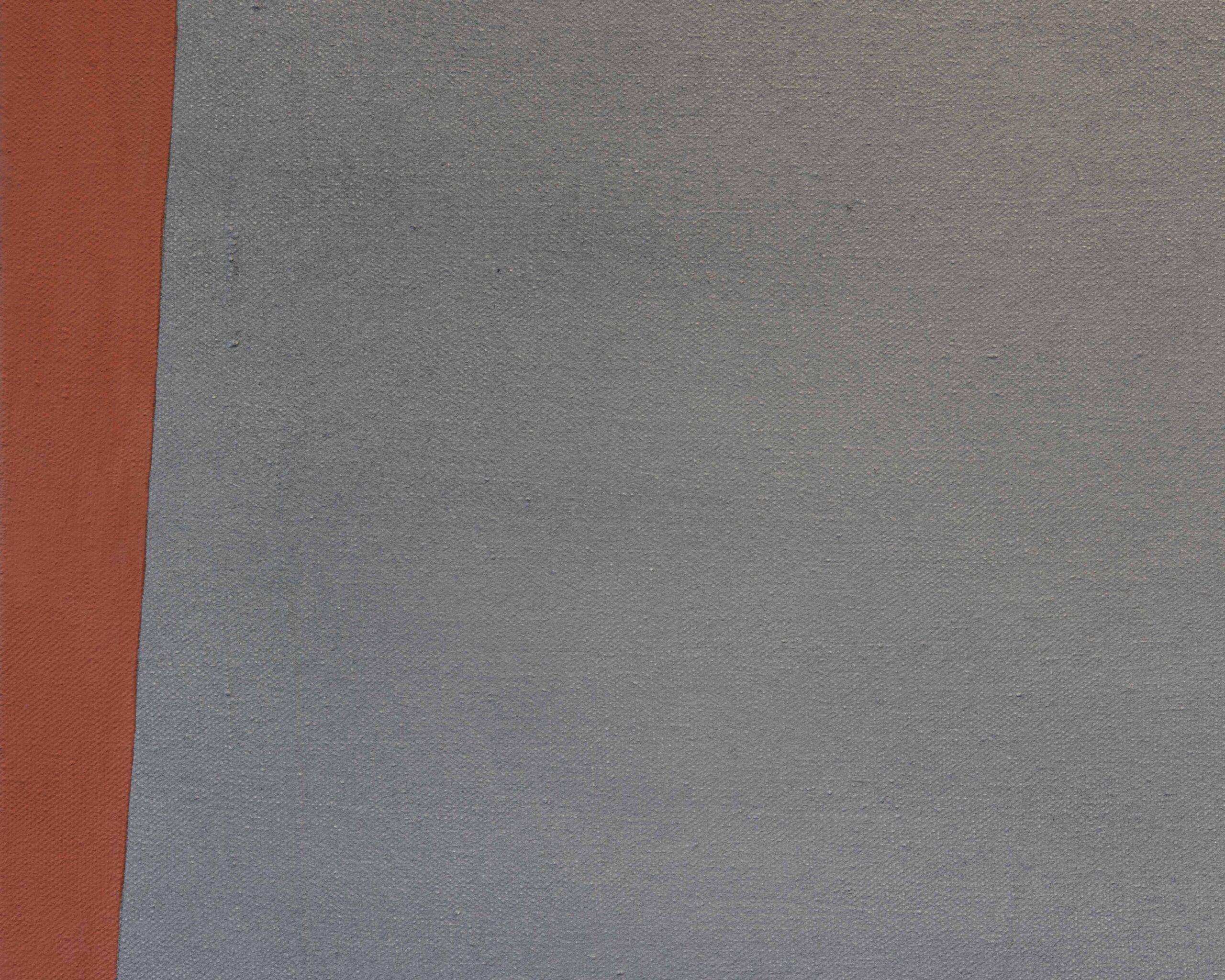
Paint detail in ‘this gap – that gap’
Despite these works appearing minimal on a screen, a large part of the reason why your works are so appealing is that they have a lot of personality within the paint. They’re not so flat.
Computers can never really give you what the real thing can. These are layered and layered with paint. Day after day, layered with real thin paints. When I’m painting them, I’m taking off other layers of paint and putting it back on, basically scrubbing them. That’s what it felt like. I could come into the studio and just put a single layer on, then move to the next painting to do the same. I’m always adjusting. This also built up a texture on them which becomes the interest. They become like cloud fields in some ways. They get to a point where I like them because of what they are.
So these final paintings emerged from a process that allows you to guide the work rather than be so strict with planning?
When you start off, from getting the stretchers, stretching the canvas, applying the gesso layers, you then have the whole thing of, ‘I have to start this now. I have to spoil this white canvas.’ You know, I have to put colour on it. There are so many questions of how am I going to start this? What am I going to use to apply the paint? What direction am I going to paint? Where in the studio will they hang? All such things affect where the work goes.
Are you looking back at a heritage of painters throughout history?
In earlier works I was interested in De Stijl and the Dutch Bauhaus. I also used to look at Gerhard Richter works. He’s gone through lots of different phases himself including quite minimal paintings. I think it’s that whole thing of old age. You get to a point where you feel like you’ve seen everything. It can be great to not look at anything – it becomes a grey area.
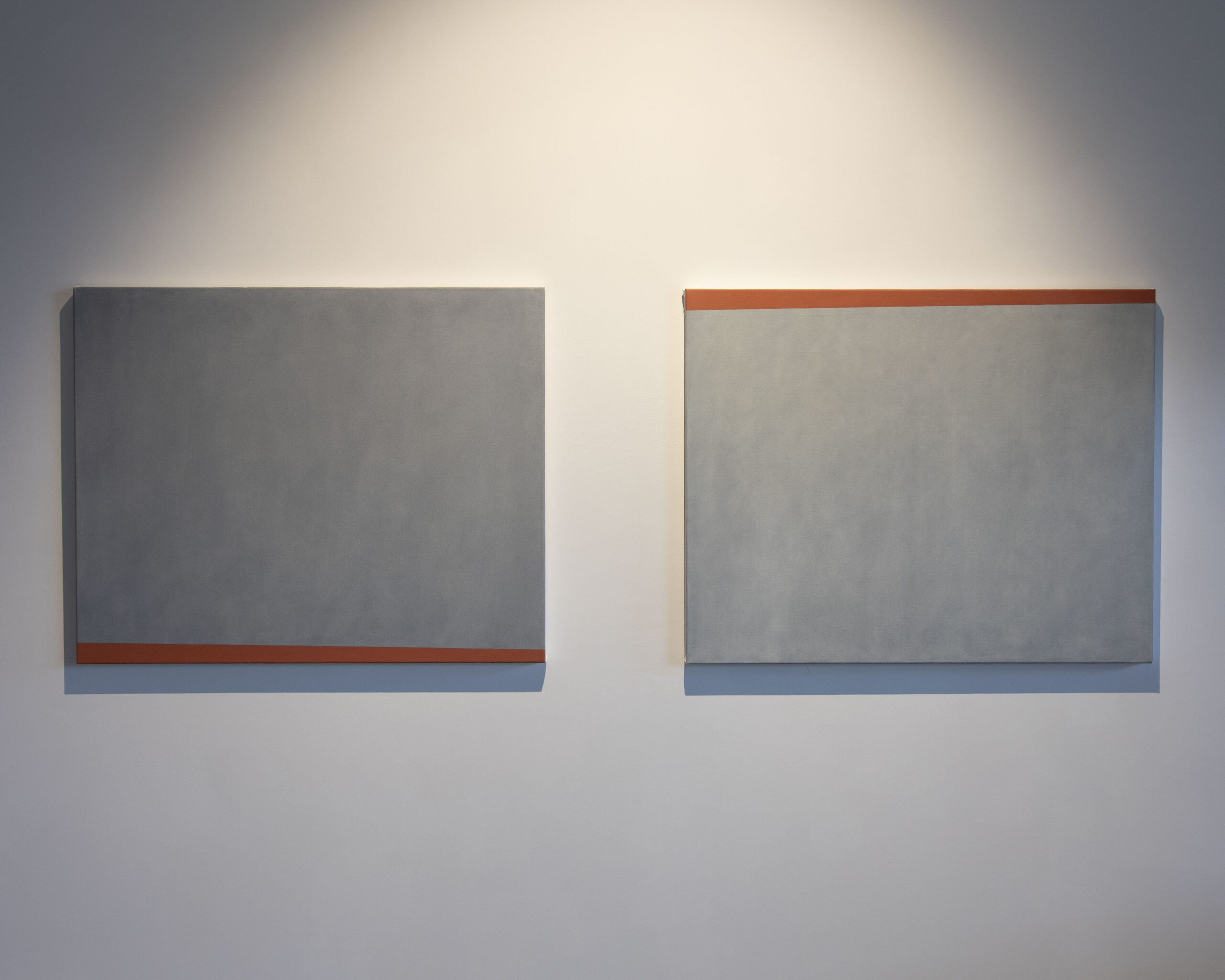
down hill – up hill, Francis van Hout, gesso, charcoal, sanguine, acrylic binder on stretched canvas, diptych 800x1000mm, 2026
Something that’s been on my mind recently is how do people interact with paintings? Why interact with a painting? And then why purchase a painting? Part of that is that there is some delivery happening from the artist, but also that a well done painting is open for, and completed by, the viewer.
Yeah, I know what you mean. What I’ve always said is that people always find what they want to find and what they’re looking at no matter what. An artist can tell them what it is, but then I think the discovery goes away and that experience becomes less personal. I like when I talk to people who have bought my works and they give me a story about why they bought it. It becomes something very personal to them.
I’ve done the work, put it on the walls – I think it’s up to the viewer and the buyer to find what they want to find out about it. I mean, the artist can give them clues, especially for abstract work, in titles and available information about them. But I think people will find what they want to find in the works. It will grate into their minds and that’s when they kind of fall in love with it. I think the individual has to discover what they want to get out of it. I do them because I like them. I live with them, basically. I’ve been living with these paintings for the last three months.
I think there is something in that idea of living with an object. I know myself from having artworks in my home for many years, the same ones that I look at, just about every day. Artworks do change with you over time.
Absolutely, works always change over time because you start looking at different things. That’s what I like about the big reflective works I’ve done. They will always change every day, no matter what. You’ll see different things in them all the time. These paintings are more like absorptions. They suck everything into them and they never reflect anything back at you. You have to go into them. You have to look close up to see the patterns and details.
There’s a very clear aesthetic appeal to the work. I think abstract work can also activate other things around it.
All the work always activate this studio space. They enliven it. Every day I come in here and watch the light changing in here and the paintings change. But you never finish works. You always want to tweak them. That’s the hardest thing.
I think people want stories as well nowadays. Stories of the works themselves. But I think they become part of the story of the artwork as well, because they’ve purchased it. They live with it, that becomes part of the story.