Sandra Thomson is an Ōtautahi Christchurch-based artist whose upcoming exhibition of drawings examines the plight of endangered species and the ethical dilemmas faced by the science of saving them. ‘Uncertainty’ opens on Tuesday the 25th of February and runs through to the 17th of March 2025. Ahead of this, she spoke with City Art Reader editor Cameron Ralston in her studio.
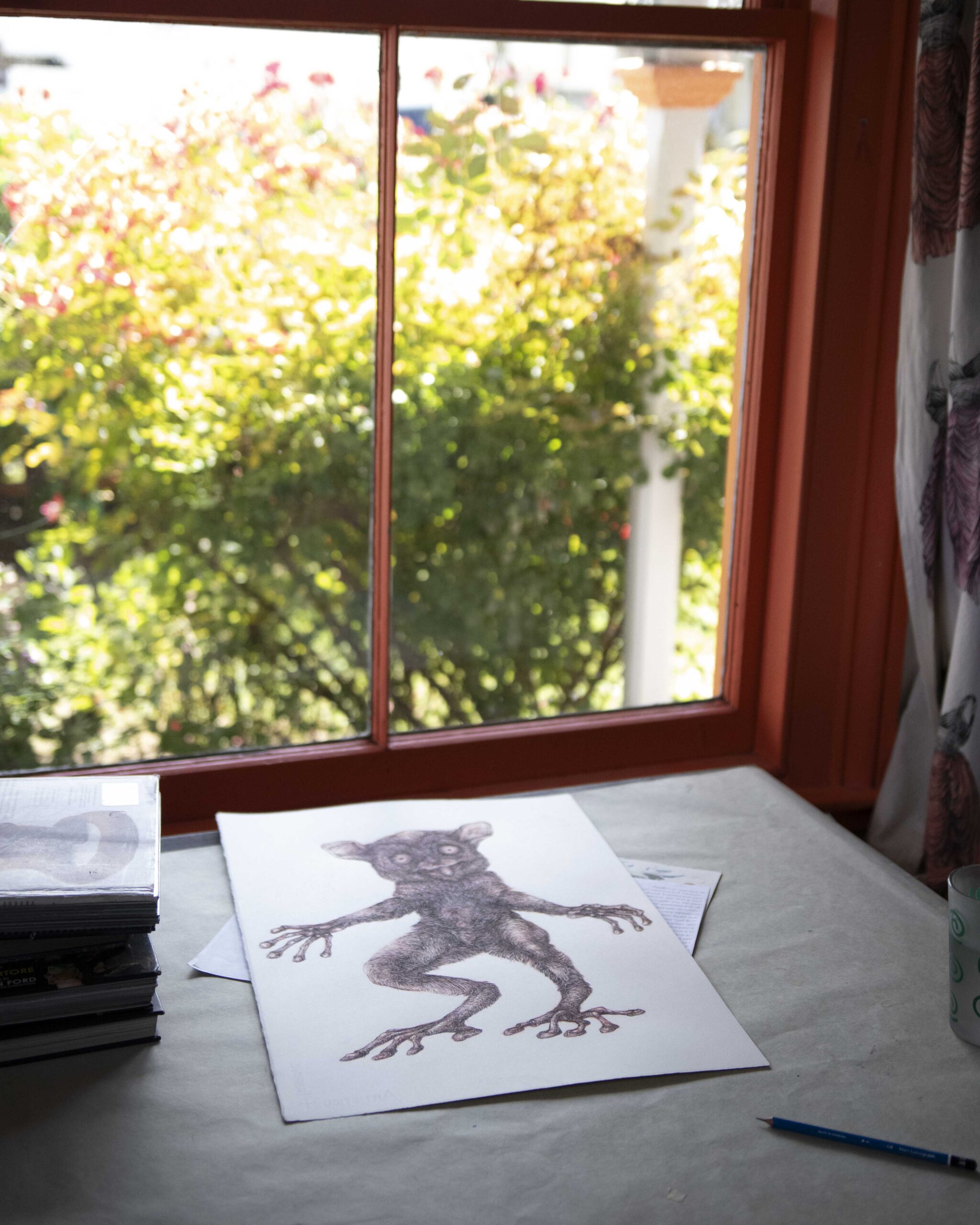
Sandra Thomson’s Christchurch studio
Cameron Ralston: What are the central themes or ideas that you’ve been working with in this body of work?
Sandra Thomson: It’s a continuation from my last show Banking (2022) and the show before, Interference (2019). Here I’m more looking at where science is now. Assisted reproduction, stem cell science and gene editing have advanced so much and can be used to increase biodiversity and save species. But then of course the question is how good are these things? Humanity must do something, but do we do too much and end up playing God?
Do you have concerns around the ethics of these sciences?
Yes. It’s almost the technical versus the moral side. There seems to be a division amongst conservationists where you get the molecular scientists on genetic rescue and then you get more traditional biological scientists who are worried about the connection of the species to the habitat and the community they live in.
Is there a bit of tension in that?
Tension, and I think that there is a worry of seeing an animal just as genes and not as a living entity that interacts with its species, habitat and ecosystem. The cultural learnings that goes on between animals. So it’s a kind of dilemma.
You can see why science advances. It’s amazingly exciting with the tracks that you could go down. But it’s a balance. That sense of playing God keeps coming up because there are decisions being made on what species will be saved and what ones aren’t saved.
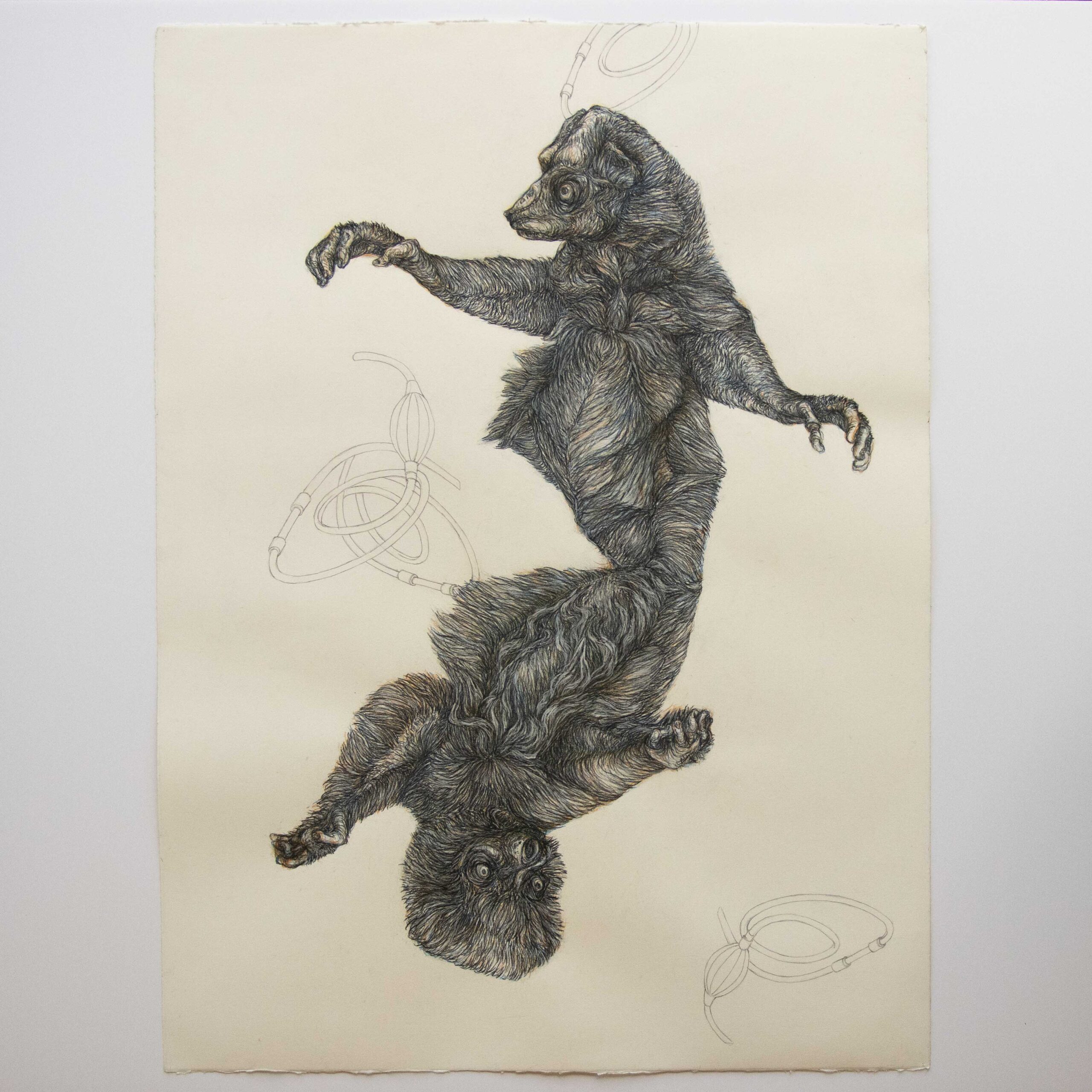
Uncertainty [3], watercolour & chalk pencil on paper, 770x565mm, 2025
Does that play a role in choosing what to depict in your art?
I try to avoid the more obvious animals. So, I try not to go for the panda. I’ve drawn maned wolves, we’ve got gibbons, the proboscis monkey (the one with big nose), black footed ferret, slow loris, camel, bats. It gets a bit hard choosing sometimes, but it’s also affected by what image references I can find to draw from.
How much research do you do into the plight or background of these animals?
They’re all creatures that are threatened. Some less than others, like the camels who can’t breed in the wild anymore, but they’re probably not on the brink of disappearing. So there’s got to be something that’s threatening what I’m drawing.
I work from an underlying body of research that examines extinction threats and approaches to saving species. I research around the individual animals I have been drawn to.
Has nature conservation always been an interest of yours?
More so over about the last decade as I became aware of species disappearing. I know it’s been going on for much longer than that.
I imagine a lot of people who view these artworks might not be aware of the particular animals and what’s going with them. Do you aspire for your work to challenge people or that it might raise awareness?
Though I don’t know how obvious it will be, it hints at the plight of animals. So yes, some awareness.
I’ve read Mary Shelley’s Frankenstein recently. It’s seen as the epitome of people’s fear of science and new knowledge and what might happen. That’s one of the things behind the works. We’re creating these creatures that we don’t quite know what they’re going to become. Frankenstein’s monster was made from lots of different human body parts, whereas now with the technology, there’s lots of different genetic parts that are making up these animals. So it’s a pulling together of DNA from different animals within a species to strengthen its chances of survival. It’s more hopeful. There are parallels with the monster that was seen as being lonely, misunderstood and abandoned and didn’t know how to live in the world. I think that’s part of the fear, that these genetically engineered animals will have to be raised in the zoo for quite some time until they learn how to feed, to communicate, to survive before they can be released into the wild.
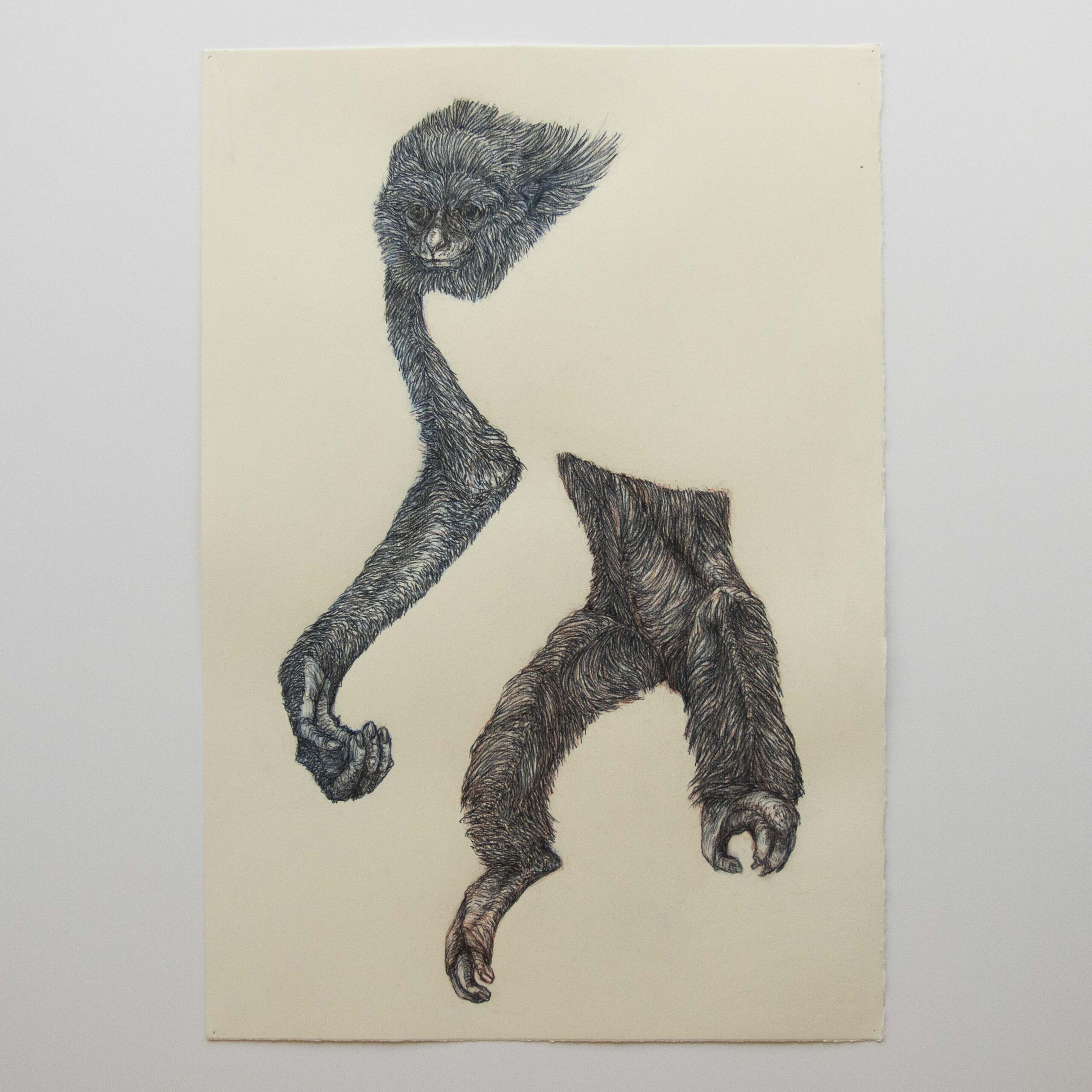
Uncertainty [26], watercolour & chalk pencil on paper, 565x385mm, 2025
How do those ideas come out in the artworks?
Well, I’m working with the fear of science in a lot of them. I wanted to create animals that are out of kilter. There are animals that aren’t really going to function properly, elements are missing, scales of parts are wrong, behaviours interfered with. This is to reflect a distrust of the science. But some of the other drawings are more straight forward reflecting the sequencing and the reassembling of genes to make a stronger animal. Often, they might not have all the DNA they need to complete the animal. So this is what I’m representing with the gaps.
Especially if they are using ancient DNA, there might not be enough ancient DNA to actually recreate the animals. So, they look for more DNA that can be used from living related species.
Some of the works do have that monster look to them.
Yes, I realised the Frankenstein’s monster idea was dominating. I kept going down that track because I was enjoying doing it.
You’ve drawn some animals with multiple heads or bodies spliced together. And you’re borrowing the language of science in an interesting way.
I tried to work a little bit like I was a scientist. I would do drawings of more than one animal from a species and then blow them up or reduce the size and then cut them up and reassemble them like the genes would be reassembled. I sort of collage to create new beings. They talk about the genetic engineering as a kind of edit, cut and paste.
In some works I have changing colours, which represents the combining of DNA from the frozen zoos with the DNA from live animals, or in some cases the DNA can be from ancient remains.
Does the title of the show ‘Uncertainty’ come from that tension we talked about?
So, uncertainty now about what animals can survive. Uncertainty about how they can be saved, and will the newly developed animals be able to exist in the wild? As well as the uncertainty around their habitats – will these still exist?
Are you hopeful about it all?
I’m not properly negative. A little bit hopeful maybe. When they’re altering genes like with the Tasmanian devil, because they’ve been dying of a mouth tumour, trying to actually alter that out of their genome, that sounds like a good positive step. I guess it’s how things are done and if they are done for the right reasons rather than egos taking over and chasing the wrong goals – like bringing back the dodo or mammoth. I think that the biological conservationists feel the molecular scientists are creating false hope that they can save a species, but they’re not actually looking so much at why things are going extinct. So there seems to be a missing part in there. Some of them are successful, like the black footed ferret, which was cloned.
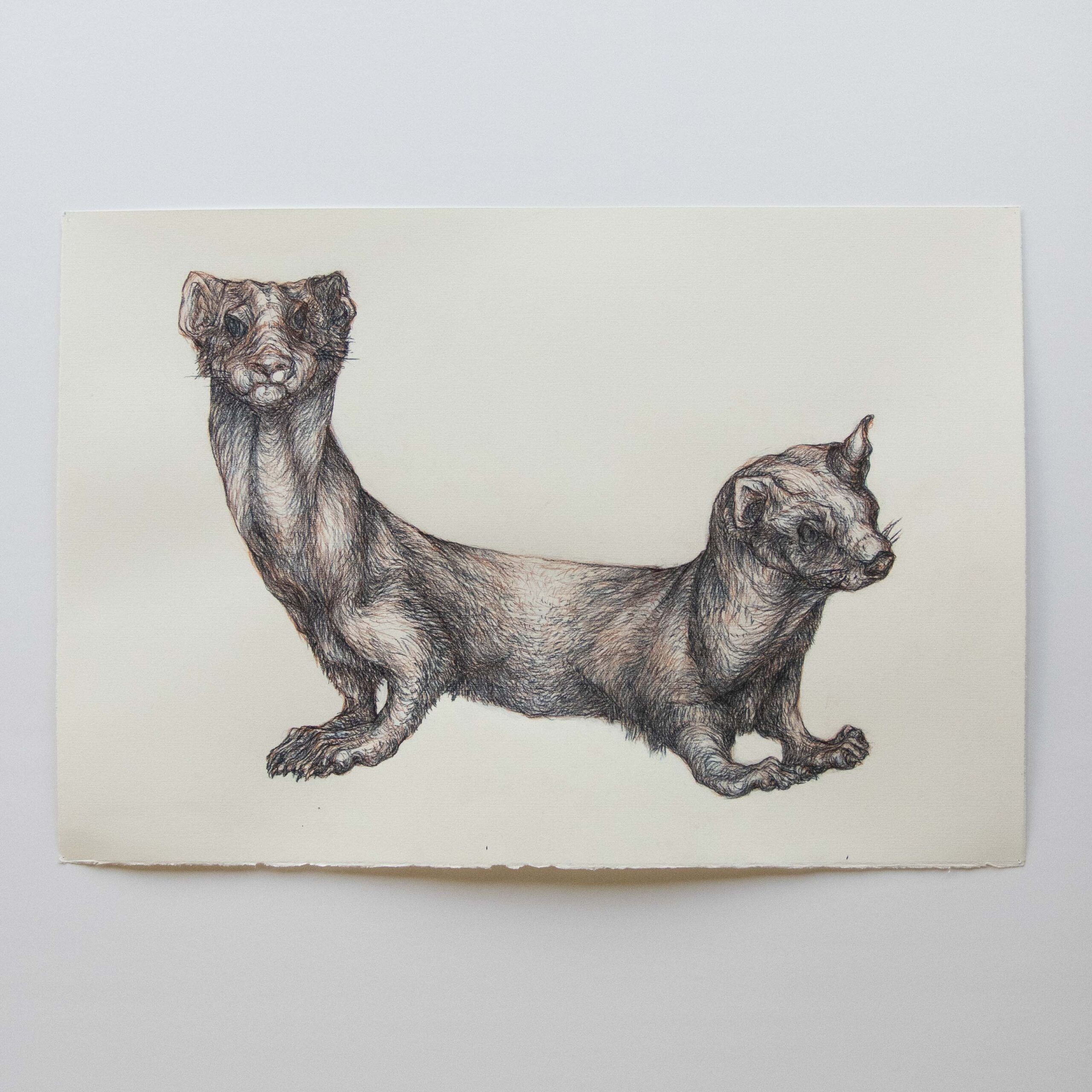
Uncertainty [17], watercolour & chalk pencil on paper, 385x565mm, 2025
The amount of work is mind boggling at times, especially seeing the often-simple causes.
Us humans! Guilt must come into this so much because we caused these problems. And if you’ve got the ability to reverse it ethically then that is positive. But which animals is the question? There are just species that warm the hearts more than others (who miss out) – I don’t know what you do because you can’t probably save all of them.
There’s a spaciousness to the work, partially because there is no surrounding habitat, just the animal, like a specimen.
Part of the fear is that these newly constructed animals will be alone. To start with there might just be one of them. Without a herd or a flock. And living only in zoos.
There is still some misunderstanding on the consciousness of animals perhaps?
Yes, there is a hierarchy hangover from biblical times where man is at the top and everything else is below. One of the books I read talked about human chauvinism and putting our ideas into how this world is evolving or developing. And how species are saved? It’s a sort of domination over nature in all its forms.
Animals are now known to have more intelligence and empathy than they were ever credited with.
Have you seen any of these animals in the flesh?
Only camels, bats and gibbons. I’ve always dodged zoos because I don’t like seeing them cooped up. When I was a young kid there used to be this little – I don’t even think you could call this a zoo – in New Brighton. And they actually had an alligator or crocodile that was in a bath, it was unbelievable.
You manage to capture some emotion, especially in the faces of the animal. Is that a considered part of the work?
When I start drawing an animal and I’m captivated by the faces, especially the eyes, there is something that comes out about them. I’m also very aware of the posture and the characteristic poses of the animals. I’m trying to capture the essence of the movement, as if they were in the wild.
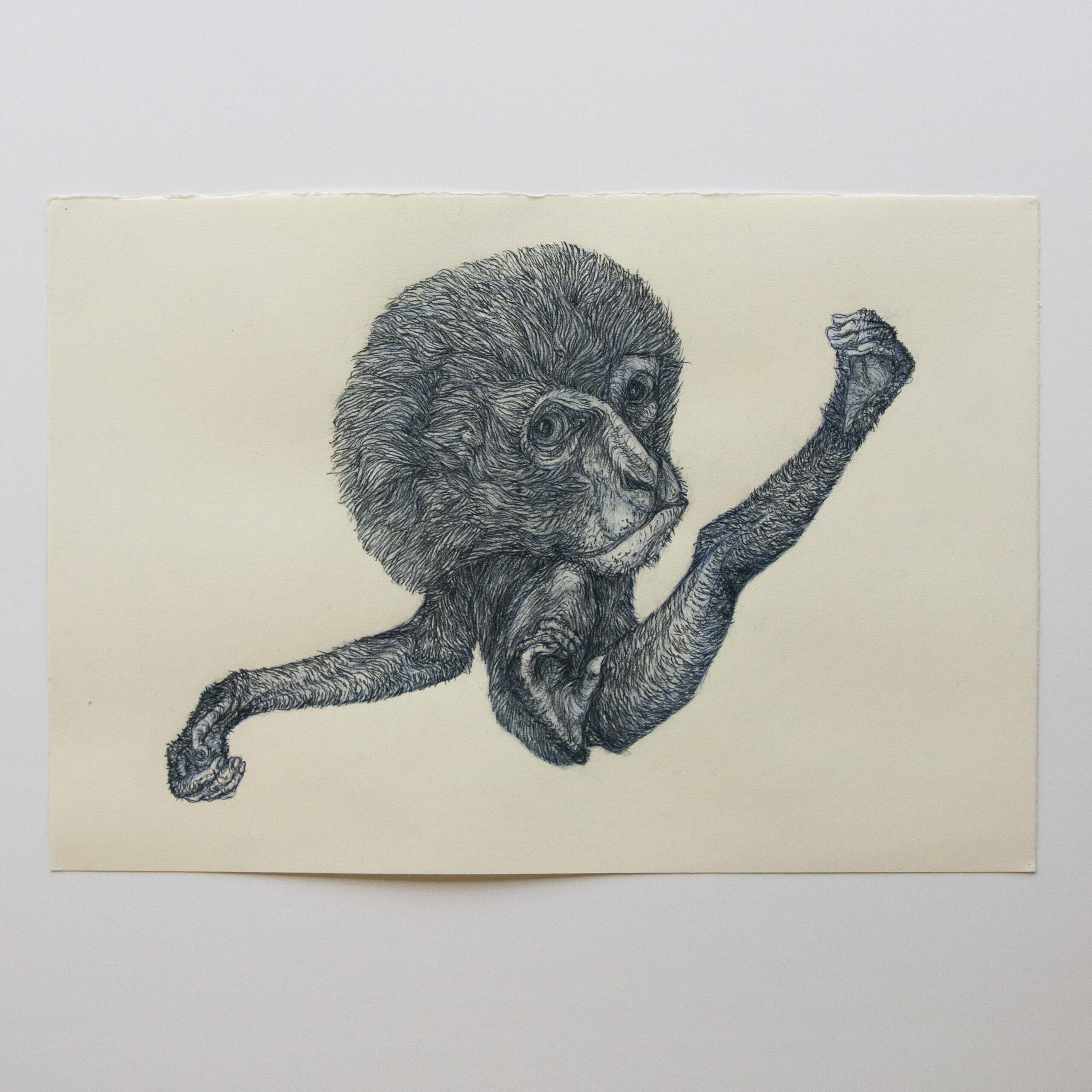
Uncertainty [8], watercolour & chalk pencil on paper, 385x565mm, 2025
What mediums have you been working with? They have this great bodily feel.
I use watercolour and chalk pencil. The pencil goes really nicely over the watercolour, it feels a bit dry when there’s no watercolour underneath it.
This is your third show with City Art Depot exploring these themes and depicting animals. Does the drawing get easier the more you do it?
No, sometimes it gets worse I think. But actually, I’ve realised that I am getting more pedantic. I can see more things that are wrong with it and then I’ll start again. Partly that comes from having more time to be in the studio and doing my work now.
Do you do a lot of studies before approaching the final work?
Yes, and a lot end up in the bin. It can take a long time to get my head around how things connect. I still don’t think I can draw a camel properly because I’m so unfamiliar with them that I could probably spend a month just doing studies. But I didn’t have time for that. I spend a lot more time working through the studies than on the final artwork. Getting to know that animal. Their proportions, shapes and form.
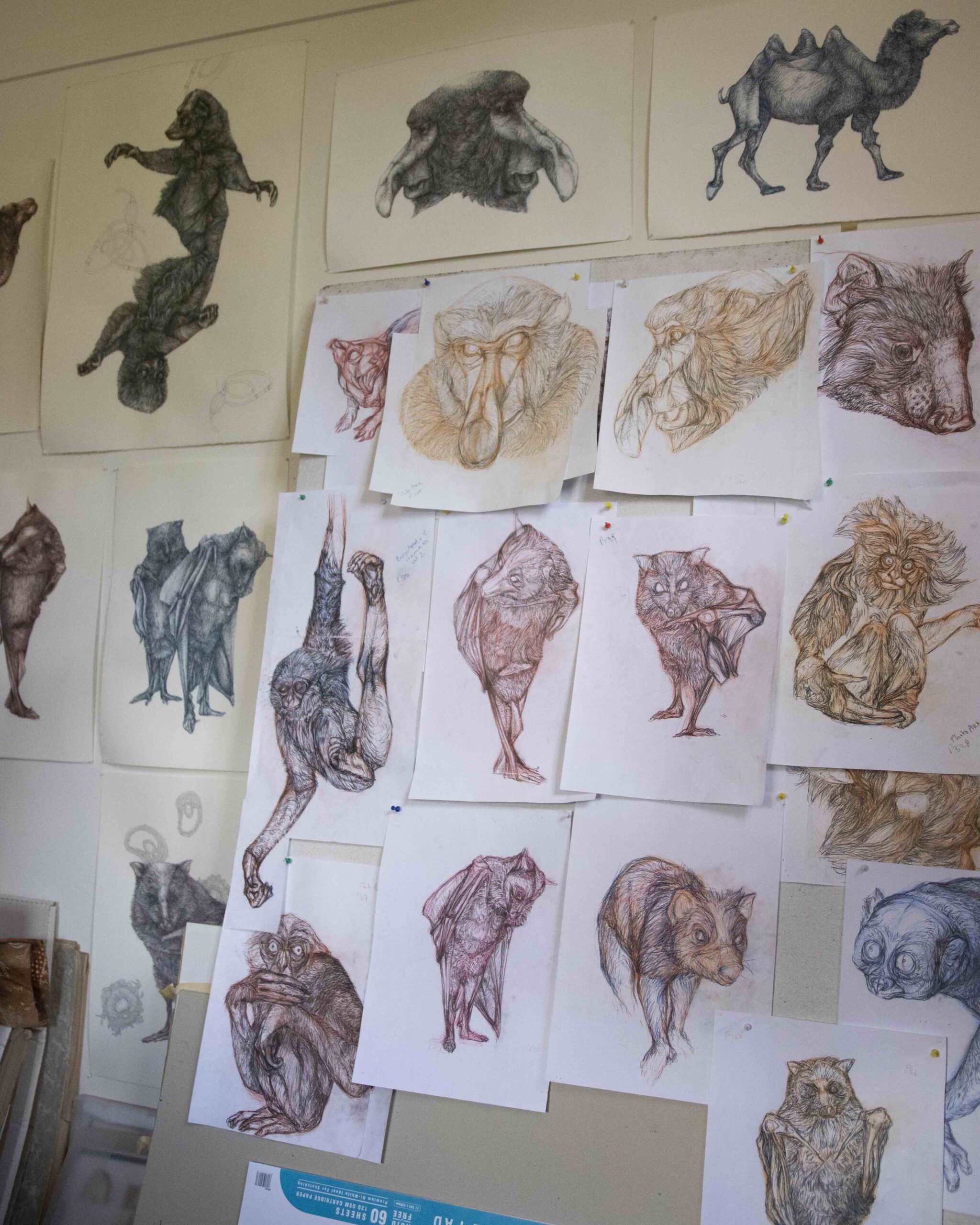
Studies in Sandra Thomson’s Christchurch studio
What are you depicting with these other forms in some of the works?
They’re from diagrams to do with assisted reproduction. The human egg and embryotic plates. Then the hosing comes from IVF technology. I kept those elements in pencil to make it sit back and not dominate the piece.
You’ve used most of the paper for each piece. It must also be difficult to know when to stop working on an artwork.
I do spend a lot of time sizing it up for that piece of paper and considering how much negative space is around. Yeah, actually there’s a limit to what the paper can take before the fibres of the paper have had enough and start to fluff up.
You’re quite prolific in the way you produce work.
Following on from my last show with the wall of frozen animal fragments, I had in my head again that I’d like a bombardment of drawings in some way. It’s always been there, that there has to be a lot of them. At one stage I was almost thinking of it as like a museum, a reflection of what had been happening scientifically. But I realise it might be quite a negative museum about that sort of thing.
In both that show and this one you’re, in a way, cataloguing the animals.
Yeah, that’s why I kept the size of the paper primarily uniform.
Your work can be quite sculptural in the way its drawn. With a kind of muscular tension in the animals’ bodies.
That’s the aim, to get a three-dimensional look to them and a feel of the animal. Sometimes it’s like I need to see a skeleton of the animal in that position. From doing quite a lot of figure drawing over the years, though the forms are different, the kind of logic of understanding underlying structure is the same. I guess I like drawing animals where you can see more of the anatomy. I find I don’t want to draw animals with round forms as much.
There’s good connection between the works through the forms, the choice of animals (all mammals) and the mediums. What is it that makes the drawings successful to you?
If I’ve actually managed to capture them or not. It’s a kind of a feeling, movement, weight and a presence. Like I say, it takes many prelim drawings to get there. They’ve got to feel alive.
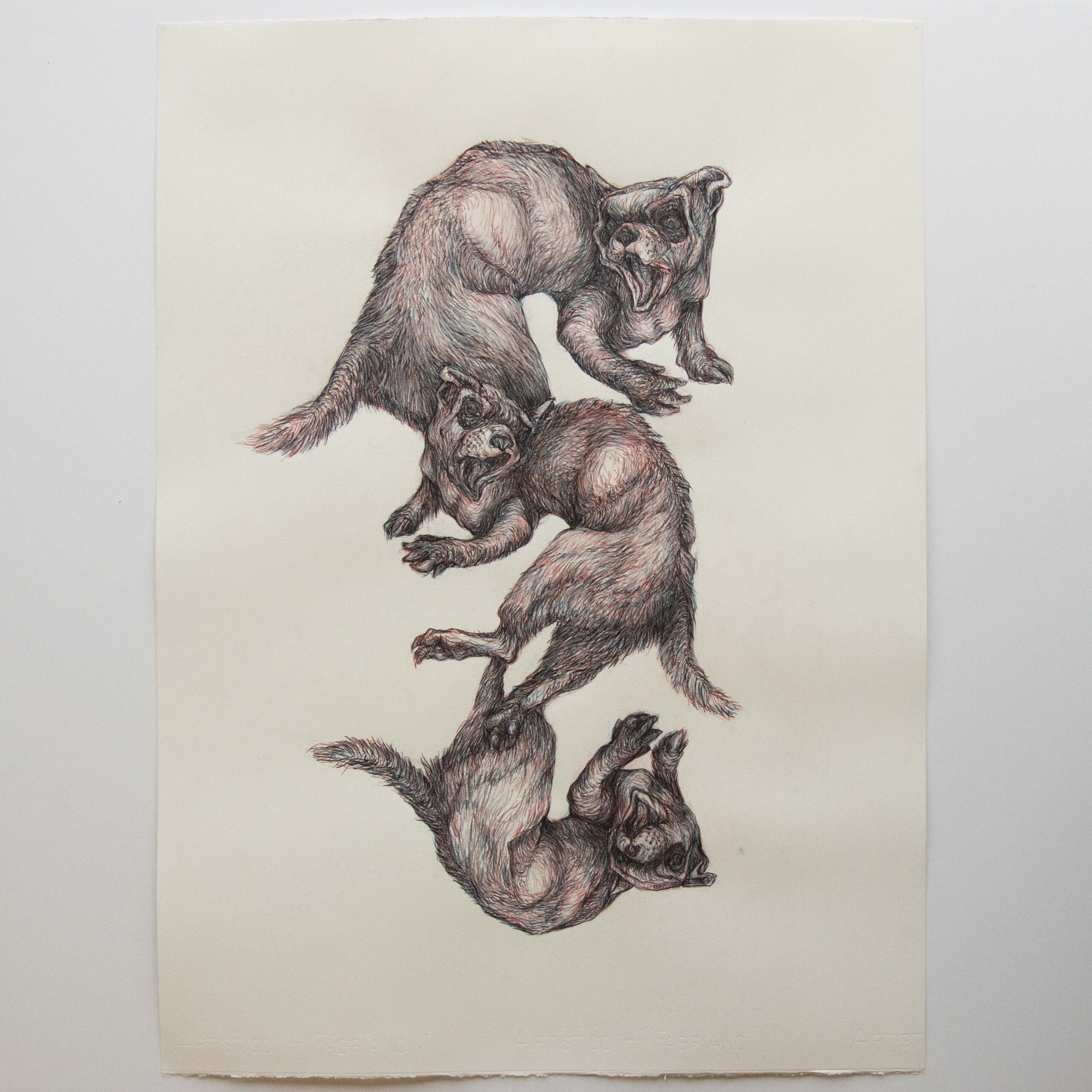
Uncertainty [4], watercolour & chalk pencil on paper, 770x565mm, 2025