Richard Elderton is an Ōtautahi Christchurch-based artist whose richly balanced oil paintings explore the edges of memory and familiarity, immersing the viewer in shifting narrative journeys. Ahead of his exhibition ‘A Wandering Perspective’, City Art Reader editor Cameron Ralston spoke with the artist. ‘A Wandering Perspective’ opens on 5:30–7pm Tuesday the 4th of August 2026 at City Art Depot. Richard will also deliver an artist talk at 1pm on Thursday the 6th of August in the gallery.
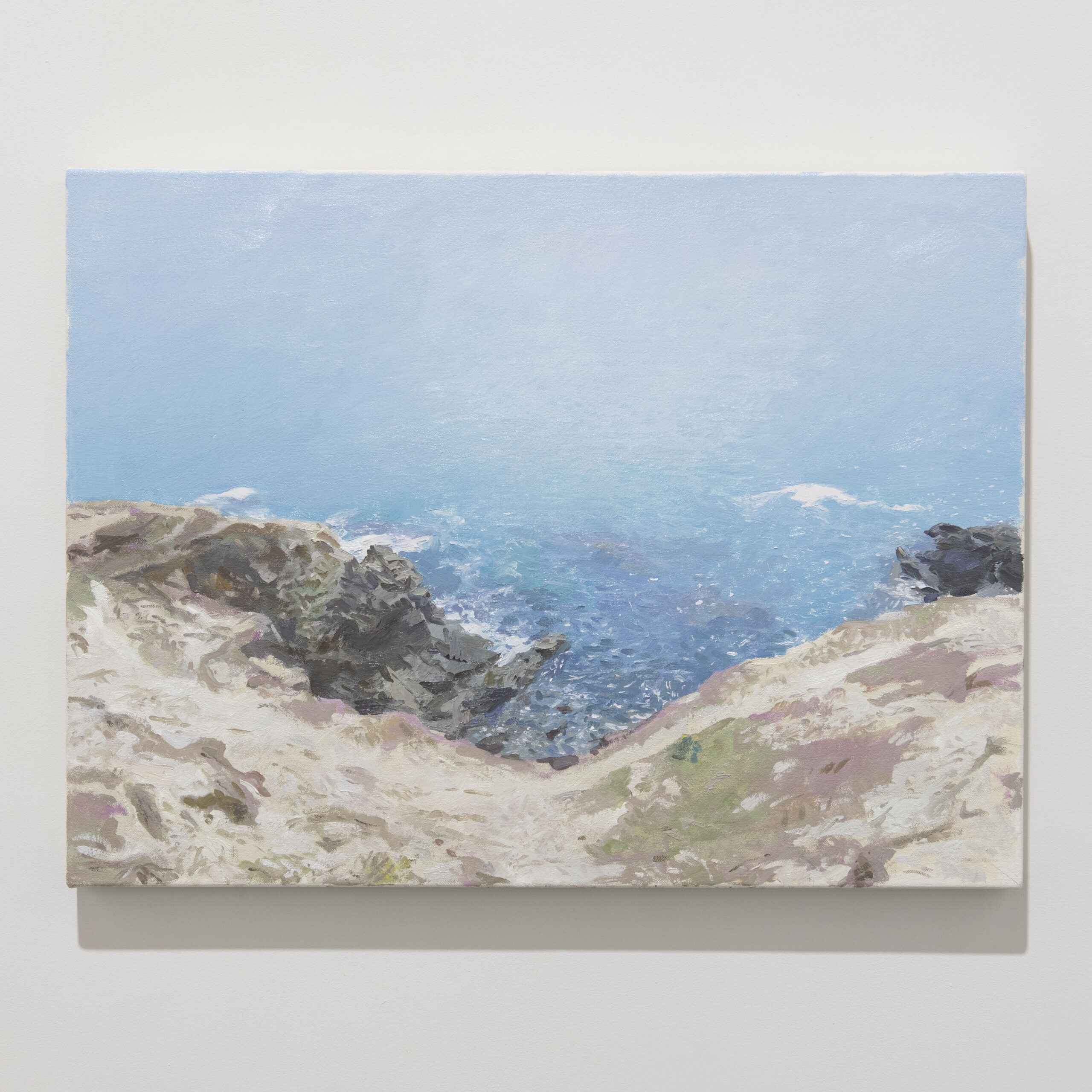
A Wandering Perspective, oil on stretched canvas, 455x610mm, 2026
Cameron Ralston: It’s often a matter of curiosity for figurative work, why the artist has landed on the subjects that they depict. You seem to have a consistency towards the natural, real, world.
Richard Elderton: I suppose I find myself always returning to realism in a broad sense of the word. I’m always drawn to art that is rooted in observations, and reflections about those observations. There’s something really moving about being able to trace what a person saw in a different time, or a different place. It has a totally different effect from art that maybe aims to transform, transcend or compete with reality. So I think when I am chasing for this feeling in my own work, the subject matter tends to be oriented in the natural world.
But for these works specifically, I had this idea of making images that related in quite a loose way to each other, and that there would be an implied narrative that would emerge out of that. I would do one artwork and then with the next work I’d try to respond to some technical things that went on in that painting or find some thematic consistency. And the next work I do would relate to that one, but maybe only partially relate to the first painting. Eventually, there would be an evolving aesthetic thread running through the paintings either compositionally, colouristically or thematically, but also a variation. Like a stream of consciousness. And to help balance the variance of the images, I decided to keep each painting to a consistent canvas size.
That was the loose starting point, but as I progressed, I started thinking implied narrative through pictures or visions. An interview with the film director Harmony Korine comes to mind. He was saying that one of the things about his films, or his cinematic experiences, is that he doesn’t seem to remember narrative very well, but when he thinks back to films he likes, he always remembers the images, the pictures or the frames. So, in the back of my mind was what story the viewer might make out of these pictures and visions. That’s where the title of the show comes from, A Wandering Perspective. It’s not so much about the figures that are depicted, the swans or the fireworks, as it is the thing you place yourself in. Paintings about the eye that’s seeing those images.
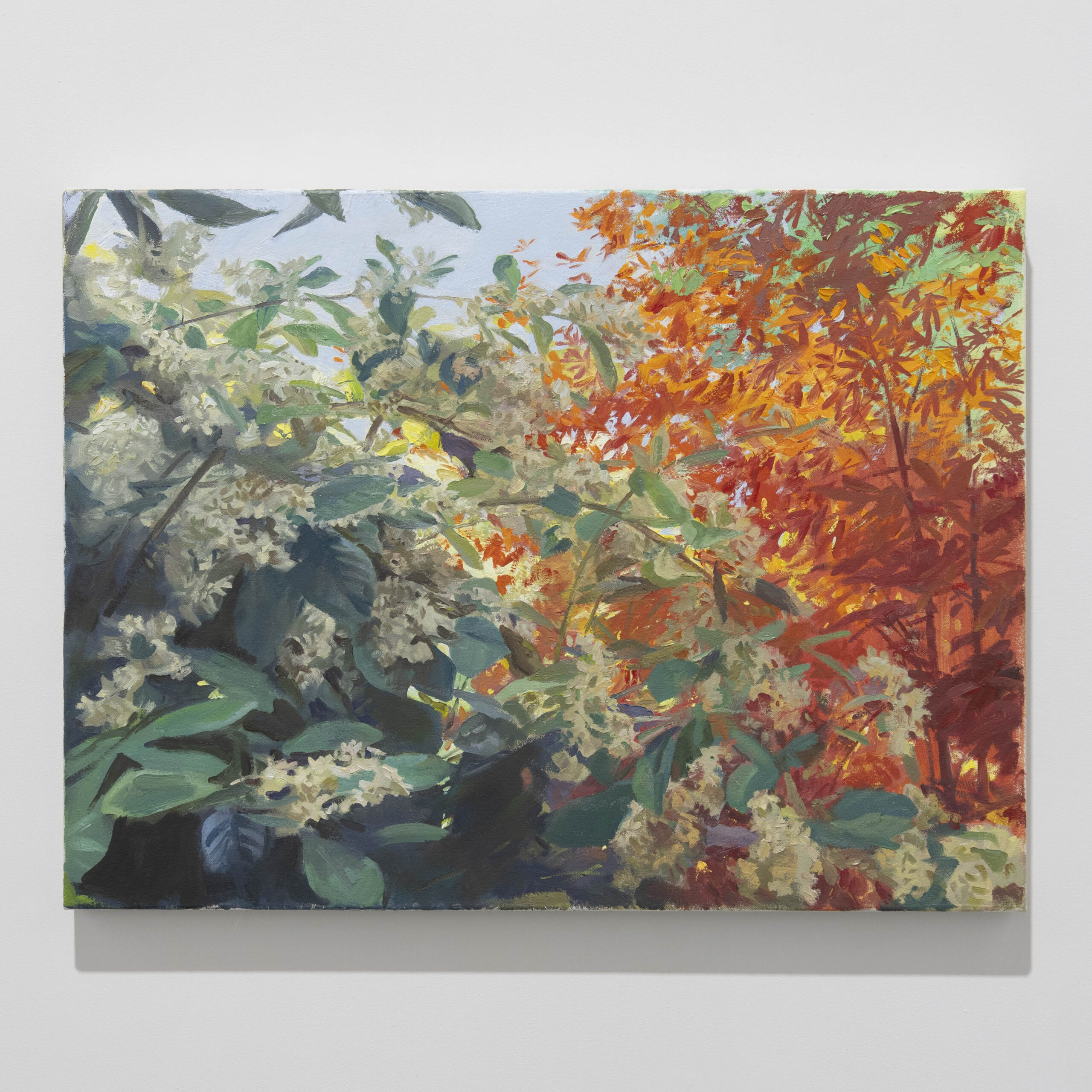
New Patterns, oil on stretched canvas, 455x610mm, 2026
There’s something film-like in the way some of these images are presented, in their framing or placement of elements. Is film a large influence on the way you approach visual culture and specifically your paintings?
I really like watching films. But recently I also have been looking at a lot of photographers. I think for this body of work photography had a big influence. I think among particularly representational painters we sort of tend to have a tricky relationship with photography. Historically, when photography started emerging there was this whole talk about the death of painting and whatnot (which I don’t necessarily agree with). I was looking at a bunch of Japanese photographers, like Lieko Shiga, Mika Ninagawa, Rinko Kawauchi, Aya Fujioka, and it was really interesting to look at how they sequenced images and also how focused they were on formalistic elements like colour and composition. As a painter you’re juggling a lot of different elements at the same time, and sometimes that process can get overwhelming because when you’re trying to mix a certain colour, for example, that process could distract you from paying attention to the overall composition. Whereas I feel like photographers have a real focus on things like framing and tone with a unique clarity that painters can learn from. So, looking at the works by photographers, including classics like Josef Koudelka, or Robert Frank or Cartier-Bresson, I was thinking a lot about compositional weighting and ideas of sequencing, which relates back to the whole implied narrative theme thing.
In relation to representation, photographers and painters often work in opposite directions towards and from abstraction. An image emerges or it is distorted. Your work has always had an intriguing interplay between those ends of the scale.
For me I try to draw inspiration from reality as opposed to necessarily documenting it. Sometimes I drift more to the documentary side than the sort of imaginative side. It’s a constant negotiation of those things.
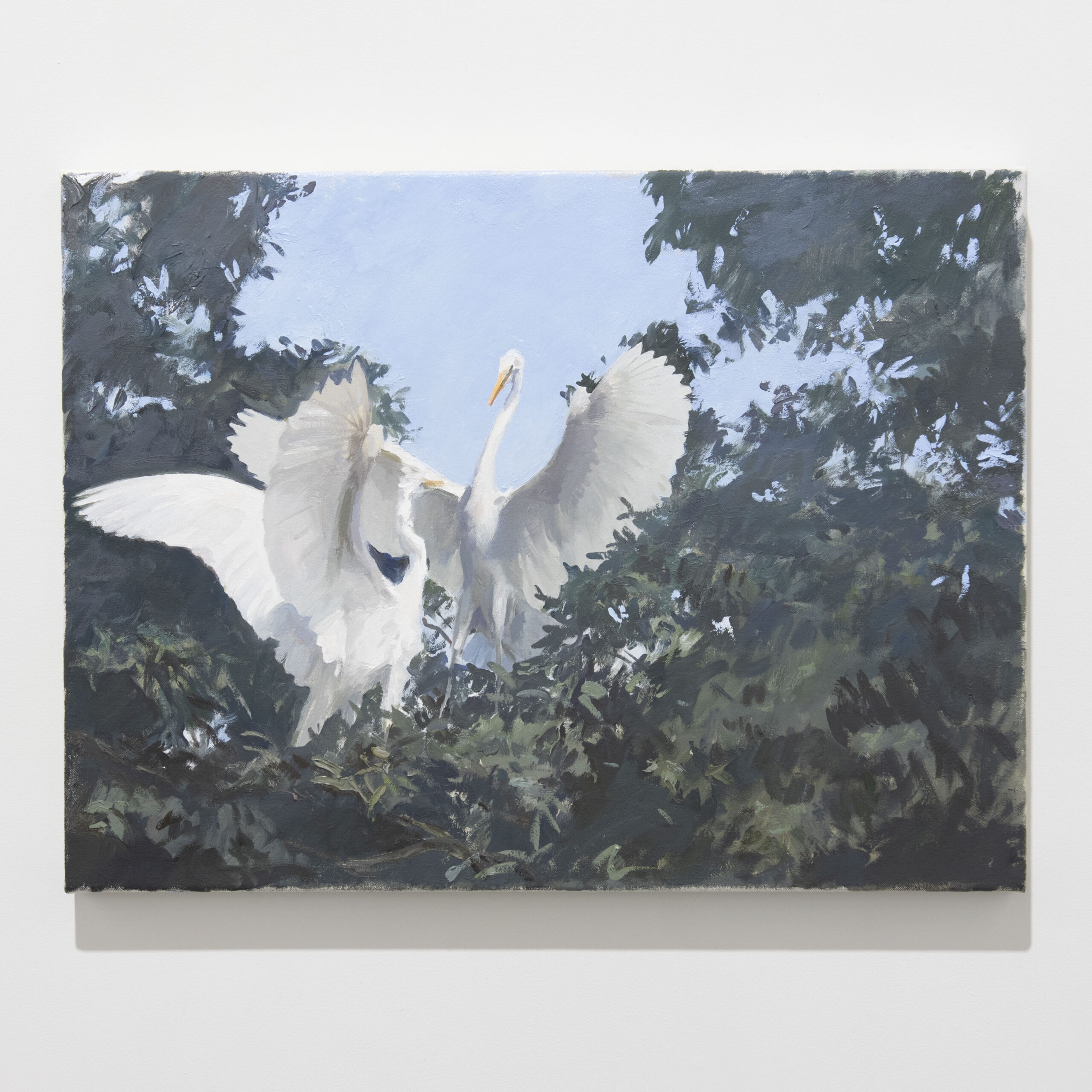
The Fight, oil on stretched canvas, 455x610mm, 2026
Are you working from photographs that you’ve taken? Are these real places and things that you’ve seen?
Yes, all of them are based on things that I’ve seen, and I’ve been working from my own photographs as well as taking a lot of videos, so maybe that goes back to the relation with cinema. I find that it’s interesting to work from videos, because unlike a photograph there is an element of change, from which I can use different aspects in the portrayal and painting. My painting ‘The Fight’ is not a rework as such, but there were two birds in the center of that previous work that were fighting. I changed the poses and composition. Working with video format allows me to revisit these things, rewind and combine different moments from the same timeline. Although I didn’t work directly from life, I had been in these places and knew what to incorporate from my experiences. But I do take my creative freedom to alter aspects of what I’m representing too.
Also going back to the photography influence, it’s interesting to me that historically, in the early days of photography, many serious painters took inspiration from it, which lead to new ways of painting, like Degas’ cropping of figures, or elements of collage. It was not about photorealism, even if there were debates about whether the photographic image was more real or not. What interests me is what photographers have done in a technical sense with the medium and how people see and think visually. The photography of today has completely changed from the photography of the 19th century, and I feel there is a lot I can learn there.
I am interested in the relationship between the subjects and yourself. Like where is the sense of self within the paintings. Is it coming through your subject matter? In respect to how you paint? Something that runs through your painting practice?
It’s an interesting question. I’m trying to be, not necessarily honest, but interested in what I’m painting, and I’m painting them because I’m interested in them for various reasons. So, there will inevitably be this sense of self that emerges from that sensibility. What kind of images I gravitate towards and what I perceive in those images. I think through also leaving the painterly process evident, it also becomes a record of not just my hand but how I think about what I’m depicting and how I think about what I’m seeing.
This will be the fifth exhibition I’ve worked with you on here at City Art Depot. So, from a standpoint of someone who’s seen the work across that time, there are things that feel carried through, intentional or not. You’re right, that is often the treatment of subject matter. Often it has a sense of tranquility, inviting escapism maybe. There’s a warmth and sincerity. And just as importantly is the way you compose an image – the colour, the application of the paint, culture and tradition.
In previous interviews we have talked about Japanese cultural traditions to do with visual language or ways of thinking. Are you still applying that? I guess after a while that sort of becomes part of what you do.
Yes, it’s definitely like that. I think it is just how I think and how I naturally perceive. But I sometimes catch myself thinking about those ideas consciously. I don’t necessarily set out to do something that feels bicultural or related to Japanese culture in a very explicit way.
Going back to the warmth, tranquility thing, I think I gravitate towards a contradictory sense of things feeling foreign, but also familiar at the same time. Or distant but also intimate. I don’t know if it’s just me, but I sometimes come across things that have that quality to them. And I’ve always been really taken by that emotion. So, that makes its way into the work.
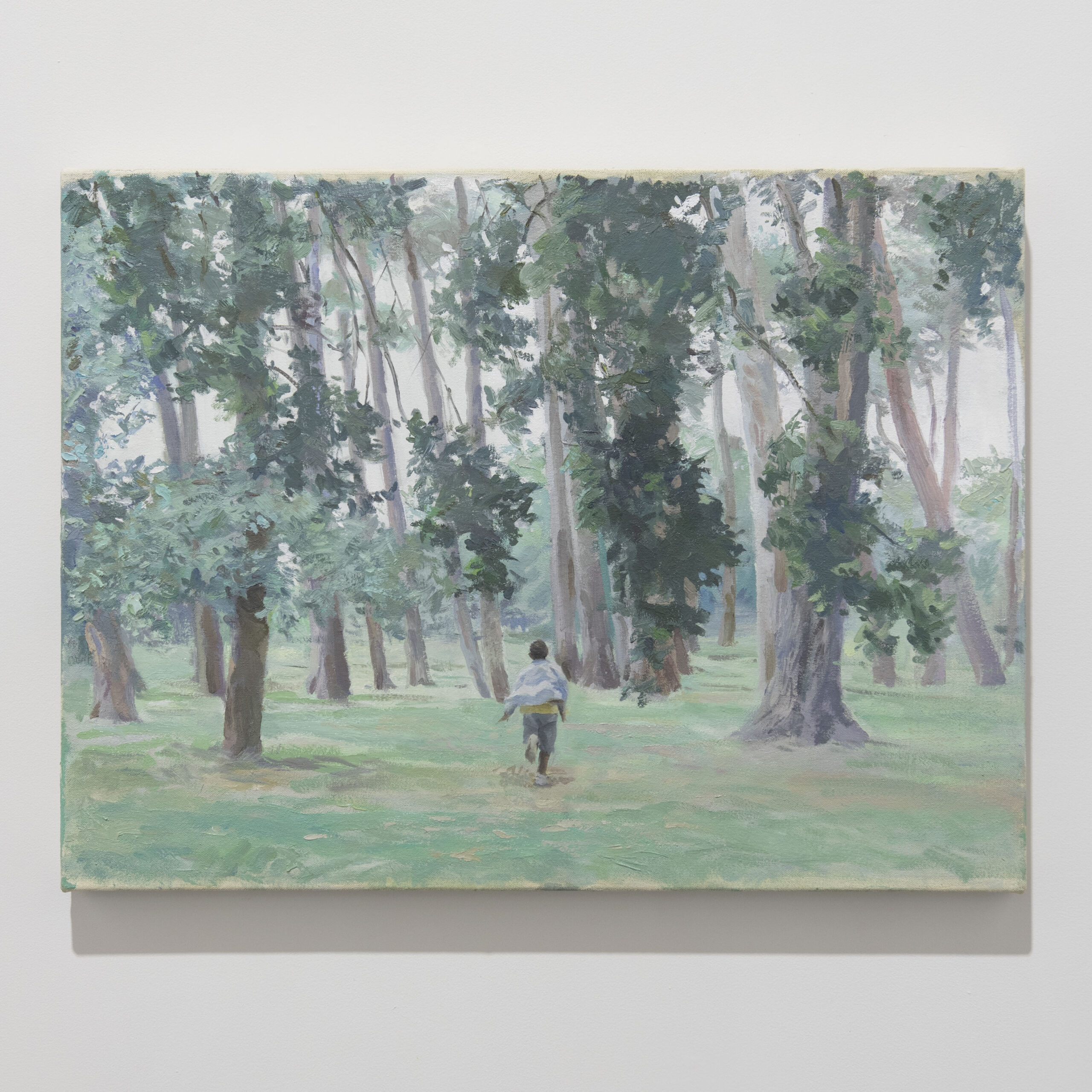
On and On, oil on stretched canvas, 455x610mm, 2026
How do you get that sense into a painting?
There are some tricks. I like to be very conscious about the distance of the perspective, the point of view, and the subject itself. In my painting ‘On and On’ the boy running away is probably the clearest example where the figure is turning its back, running away from the point of view, and then you have these branches in between the subject matter and the point of view. That creates a kind of a distance. I also try to maintain a level of realism that creates the familiarity and immersion into the subject matter. There is a kind of oscillation that happens there. I try to approach each work differently, and I discover things that achieve a similar effect, but in different ways.
How much of the work you’re doing is research and study? In the past we’ve talked about an academic type of painting, which seems to be mixed with an intuitive progression through the work.
It feels like a constant negotiation, a constant battle between the two. I have these critique sessions with friends and we often talk about this dynamic of control and intuition or emotion and how to navigate that. There’s really no answer to it. But in the process of painting, it definitely goes through these waves, when you intuitively know when you’ve tried to control the thing too much, and then you sort of try to loosen up, try to let go and try to disrupt it in certain ways. For me, when I start to lose that sense of realism or tangibility, the sense that I could reach out and be there, I start to want to bring it back into that sphere of observations, so I try to gain a bit more control. It’s not a straightforward thing. There’s no formula or kind of real strategy to be able to talk about it.
In that way of working, you end up with focal points of tangibility, legibility, which you can cling onto. But then you create these more abstract, loose, maybe even playful at times moments. I’m looking at areas such as the light on the water or the outer edges of plant’s foliage. But you still maintain a nice relationship between how the real and abstract look.
With a lot of those abstract sections, it’s nice when I look back at them and I don’t know how I did it. That’s what you’re trying to discover, a painting that’s kind of beyond your conscious decision-making. But you can also run into this problem of having certain sections in a painting that you don’t know how you’ve achieved it, it miraculously appeared and you love it, but it’s disrupting everything around it. That’s an example of when you run into this conundrum of choosing control or intuition? Sometimes I have to make tough decisions of bringing those areas back into control to allow more areas of freedom.
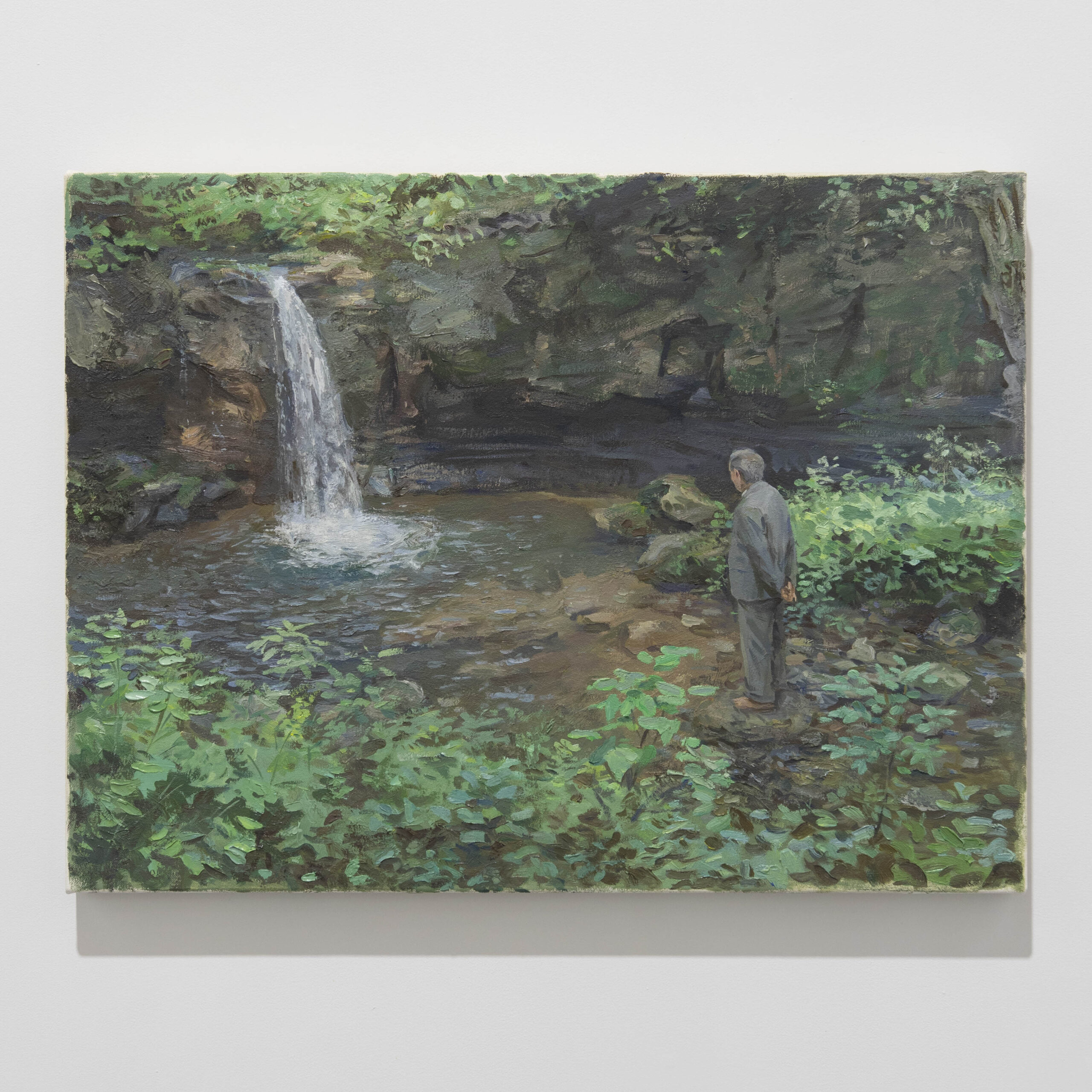
Now and Then, oil on stretched canvas, 455x610mm, 2026
You’ve been increasingly using figures in your work. Is it something you’ve become more comfortable with?
I feel comfortable about it. The major question with figuration is: why this figure? The figures in my work are not real people, I made them up. But in a sense, they’re metaphors of people. These two figurative works are the two works that I started with. I had this idea of there’s a boy running away and then there’s an old man standing and then the rest of the images will fill the gaps in between. Like a life story. If I can find a reason to paint a figure, then I’ll paint them. It’s not necessarily that I’ve been shying away from figures, but more often than not I just don’t have a reason to paint them.
Your painting and subject matter especially is influenced by places you’ve been to, thinking back to your previous exhibition as scenes from Japan. You’ve recently travelled to Europe too, has that had an effect on your work?
Not yet. Well, it did in the technical painting process, but I’d already started this body of work by then. I need to process what I’ve got first before I can make the next step in that sense. In my previous show here there was heavy influence from Japan, and then in my Suite show in Auckland there were influences from the local scenes here in New Zealand. I think this body of work is a combination of the two, some like the heron and waterfall explicitly take from Japan, and others from around here, but the two cultural aesthetics still kind of merge.
It’s hard not to be inspired by things in Europe. You just come across them and they’re breathtaking. Every now and then I had to snap out of it and remind myself to focus and think, this is really beautiful and amazing, but how does it relate to me and my experiences?
I’ve been doing a bit of thinking about the relationship between the artist and the artwork, spurred on by conversations with Kim Pieters, who writes about the artist as a catalyst. You’re kind of gifting a part of yourself out there into the world, but in a way that the artwork is of you, sustaining, not taking.
We’ve previously talked a little bit about T.S. Eliot, and in some of his essays he’s talked about the relationship of the poet and the works of literature. He used the metaphor of the artist as the catalyst in a chemical reaction. He rose to fame at the height of Romanticism, where art was seen as this expressive mode, where the artist would pour their hearts out, but he rebelled against that in the early stages. I like both sides, of course, but I do like this idea that you give part of yourself as an artist, but you try to combine external things, and you end up with this third thing, which is the artwork. It isn’t a direct expression of myself, but comes from me working with these other elements, and maybe in that chemistry the artwork is able to become something else, larger than the sum of its parts, beyond my own feelings and ideas.